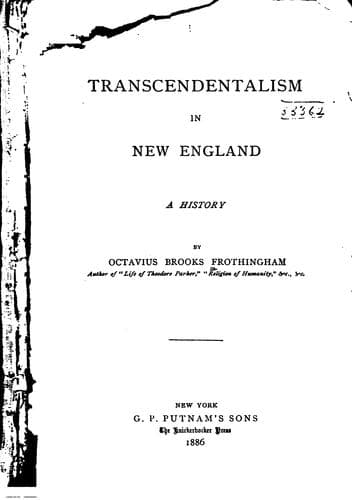
Transcendentalism in New England: A HistoryFrothingham, Octavius Brooks
Philosophy
Transcendentalism in New England: A History
Frothingham, Octavius Brooks
Transcendentalism (New England)
Very early in his career Mr. Channing committed himself to the
transcendental philosophy as interpreted by the French School, for he
possessed the swiftness of perception, the felicity of exposition, the
sensibility to effects, the passion for clean statement and plausible
generalization that distinguish the French genius from the German and
the English. The introduction to Jouffroy's Ethics contained the
principles of the French school of philosophy, which, to judge from his
approving tone, he had himself accepted:
That Psychology is the basis of Philosophy.
That the highest problems of Ontology may be solved by inductions from
the facts which Psychology ascertains.
That Psychology and the History of Philosophy reciprocally explain each
other.
With these ideas firmly fixed in his mind he went forth on a prophetic
mission, to which he remained unfalteringly true.
We saw him first at a convention in Boston called by the reformers who
demanded the abolition of the gallows. There were several
speakers--Edwin H. Chapin, then in the days of his moral enthusiasm,
Wendell Phillips, already known as an agitator and an orator--all spoke
well from their different grounds, but the image of Channing is the most
distinct in mind to-day. His manner, attitude, speech, are all
recalled. The arguments he used abide in memory. He wasted words on no
incidental points of detail, but at once took his stand on the principle
of the idealist that man is a sacred being, and life a sacred gift, and
love the rule of the divine law. Chapin thundered; Phillips criticized
and stung; Channing burned with a pure enthusiasm that lifted souls into
a celestial air and made all possibilities of justice seem practicable.
He did not argue or denounce; he prophesied. There was not a word of
scorn or detestation; but there were passages of touching power,
describing the influence of gentleness and the response that the hardest
hearts would give to it, that shamed the listeners out of their
vindictiveness. On the anti-slavery platform his attitude was the same.
There was no more persuasive speaker.
In the controversy between the Unitarians of the transcendental and
those of the opposite school, Mr. Channing's sympathies were with the
former, but he took no very prominent public part in it. He was averse
to controversy; questions of sectarian opinion and organization had
little interest for him. His mind lived in broad principles and positive
ideas; the method he believed in was that of winning minds to the truth
by generous appeals, and so planting out error. Against everything like
injustice or illiberality, his protest was eager, but he was willing to
leave polemics to others; what he said was in the strain of faith in
larger and more inclusive beliefs. He had a passion for catholicity,
which came partly from his temperament, and partly from the eclecticism
he professed. His word was reconciling, like his influence, which was
never associated with partisanship.
Public-domain text, read in full here on John Shaqi.
Reviews
Reviews
No reviews yet
Be the first to share your thoughts on this work.
Elsewhere in the archive
Join the Discussion
Join the discussion
Sign in to leave a comment or review.
Sign InorCreate an account