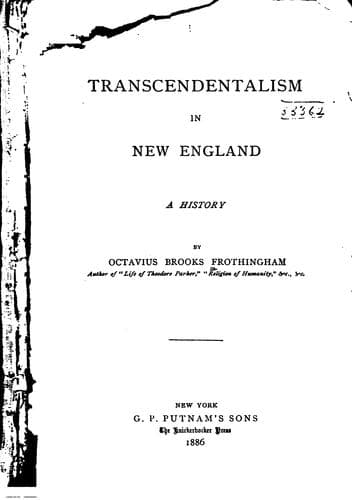
Transcendentalism in New England: A HistoryFrothingham, Octavius Brooks
Philosophy
Transcendentalism in New England: A History
Frothingham, Octavius Brooks
Transcendentalism (New England)
Mr. Channing was early attracted to the bearings of the spiritual
philosophy on the problems of society, the elevation of the working
classes, the rescue of humanity from pauperism and crime. As an
interpreter of Christian socialism his activity was incessant. He took
part in the discussions that led to the experiment of Brook Farm, and
was acquainted intimately with the projecting of it, having himself
entire faith in the reorganization of society on principles of equity.
Had circumstances permitted--he was then minister to a church in
Cincinnati, and much occupied with professional duties--he would have
connected himself with the Brook Farm Association. As it was, he visited
it whenever he could, spending several days at a time. In 1844, when the
union was formed with the New York Socialists and the leaders went out
to enlighten and stimulate public sentiment on the subject, Mr. Channing
did faithful work as a lecturer. He was president of the Boston Union of
Associationists, and wrote a book on the Christian Church and Moral
Reform. From the first, being of a speculative, philosophical and
experimental turn of mind, he entertained more systematic views than
were common among New England socialists, but the principle of love was
always more to him than opinions or schemes. His views coincided with
Fourier, but his heart was Christian. On the failure of the associated
plans of his friends, and the cessation of interest in Socialism on this
side of the Atlantic, his thoughts turned towards the Christian Church
as the providentially appointed means of obtaining what the Utopians had
failed of reaching. He was never a Churchman; never abandoned the views
that made him an independent preacher; but he never lost faith in the
ministry; his hopes turned toward the institutions of religion as having
in them the ideal potencies he trusted; he looked for faith and love in
the Gospel, and sought to draw out the lessons of charity that were
inculcated by Jesus; to deliver these from the hands of the formalists
and sectarians; to make peace between parties and churches; to discover
common ground for all believers to stand and labor on--was his aim. Had
his faith not been inclusive of all forms of the religious sentiment, he
might, in England, where he resided so long, have been a
broad-churchman. But Christianity, in his view, was but one of many
religions, all essentially divine, and he could not belong to any church
less wide than the church universal.
During a portion of the civil war, Mr. Channing was in Washington
preaching the gospel of liberty and loyalty, and laboring in the
hospitals with unflagging devotion, thankful for an opportunity to put
into work the enthusiasm of his passionate soul. Later, he revisited his
native country, and showed his interest in the cause of religious
freedom and unity.
Public-domain text, read in full here on John Shaqi.
Reviews
Reviews
No reviews yet
Be the first to share your thoughts on this work.
Elsewhere in the archive
Join the Discussion
Join the discussion
Sign in to leave a comment or review.
Sign InorCreate an account