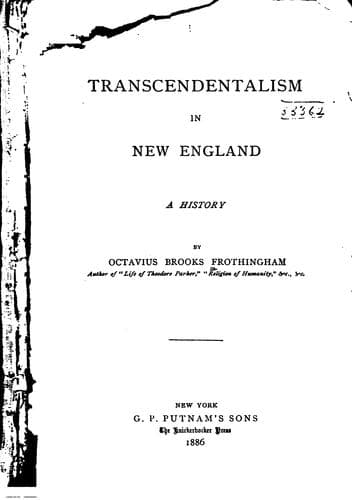
Transcendentalism in New England: A HistoryFrothingham, Octavius Brooks
Philosophy
Transcendentalism in New England: A History
Frothingham, Octavius Brooks
Transcendentalism (New England)
The name of Channing is conspicuous in the history of American idealism.
Another nephew of Dr. Channing, William Ellery Channing,--a man of
original force of mind and character, a bold adventurer in literature
and life, of independent ideas, principles and deeds, an abolitionist,
a friend of Garrison and Parker, reformer and philosopher, author of
many volumes--wrote poetry and prose for the "Dial" and, in 1873, a life
of Henry Thoreau.
In the list of the Transcendentalists Cyrus Augustus Bartol must not be
forgotten, a soaring mind enamored of thoughts on divine things,
inextricably caught in the toils of speculation. Acute and brilliant,
but wayward; with a quick eye for analogies, fanciful and eccentric, of
clear intuitions, glimpses, perceptions astonishingly luminous; but
without fixed allegiance to system, and therefore difficult to classify
under any school. In the Unitarian controversy, which was a tryer of
spirits, it was not always plain to observers in which camp he belonged;
not that his fundamental principle was unsteady, but because his curious
and critical mind was detained by considerations that others did not
see; and his absolute sincerity gave expression to the moods of feeling
as they passed over him. Some words in Parker's farewell letter to him
seem to imply that at critical junctures they had been on opposite
sides, but the difference could scarcely have touched fundamental
truths. No man was further from the school of Locke, Paley or Bentham
than C. A. Bartol. His Transcendentalism had a cast of its own; it was
not made after any pattern; it took its color from an original genius
illuminated by various reading of books, and by deep meditation in the
privacy of the closet, and the companionship of nature of which he is a
child-like worshipper. No wealth of human sympathy prevents his being a
solitary. His song is lyrical; his prophecy drops like a voice from the
clouds. In the agitations of his time he has had small share; organized
and associated effort did not attract him. To many he represents the
model Transcendentalist, for he seems a man who lives above the
clouds,--not always _above_ them, either.
His faith in the soul has never known eclipse. It waxes strong by its
wrestling, and becomes jubilant in proportion as nature and life try to
stare it out of countenance. Ballast is wings to him.
Public-domain text, read in full here on John Shaqi.
Reviews
Reviews
No reviews yet
Be the first to share your thoughts on this work.
Elsewhere in the archive
Join the Discussion
Join the discussion
Sign in to leave a comment or review.
Sign InorCreate an account