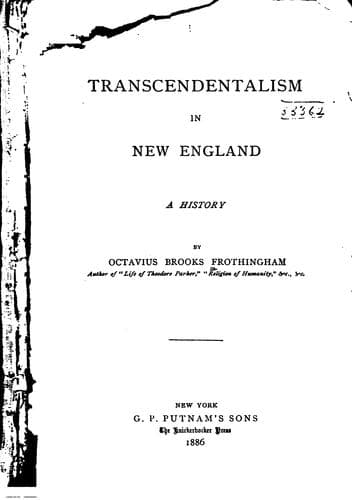
Transcendentalism in New England: A HistoryFrothingham, Octavius Brooks
Philosophy
Transcendentalism in New England: A History
Frothingham, Octavius Brooks
Transcendentalism (New England)
A few words on the literary fruits of Transcendentalism will fitly close
this history. To gather them all would be exceedingly difficult, but
that is not necessary, and will not be required. The chief results have
already been indicated. The indirect influence may be left unestimated
in detail. Transcendentalism has more than justified itself in
literature. The ten volumes of Emerson's writings, including the two
volumes of poetry, are a literature by themselves; a classic literature
that loses no charm by age, and which years prepare new multitudes of
readers to enjoy.
The writings of Theodore Parker contain much that entitles them to a
permanent place in letters. Could they be sifted, compressed, strained,
the incidental and personal portion discarded, and the human alone
preserved, the remainder would interest, for many years yet, a numerous
class of men. In their present condition they are too diffuse, as well
as too voluminous and miscellaneous to be manageable. The sermon style
is unsuited to literature, and Parker's sermon style was especially so,
from its excessive redundancy. He paid little heed to the literary laws
in his compositions, which were all designed for immediate effect.
Aside from the fatal injury that the process must do to the intellectual
harmony of the work, there is an objection to abbreviating and
abstracting when an author does not perform the task for himself, for no
other is credited with ability or judgment to do it for him. In Parker's
case the difficulty would be more than commonly great, for the reason
that it is not a question of omitting volumes, or even chapters, but of
straining the contents of pages,--"boiling down" masses of material,
till the spiritual residue alone is left. There is no likelihood that
such a task will ever be performed, and therefore his writings must be
placed in the rank of occasional literature, valuable for many days, but
not precious for generations.
Brownson's writings were astonishingly able, particularly his
discussions in the Boston "Quarterly Review;" but their interest ceased
with their occasion. His philosophical pieces have no value. They served
polemically an incidental purpose, but having no merit of idea or
construction, they perished.
The papers of Mr. Alcott in "Tablets" and "Concord Days," are thoughtful
and quaint, written with a lucid simplicity that will always possess a
charm for a small class of people; but they have not the breadth of
humanity that commends writings to the general acceptance; nor have they
the raciness that makes books of their class spicy and aromatic to the
literary epicures who never tire of Selden or Sir Thomas Browne.
Public-domain text, read in full here on John Shaqi.
Reviews
Reviews
No reviews yet
Be the first to share your thoughts on this work.
Elsewhere in the archive
Join the Discussion
Join the discussion
Sign in to leave a comment or review.
Sign InorCreate an account