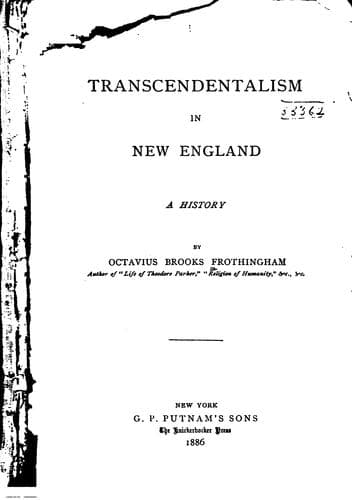
Transcendentalism in New England: A HistoryFrothingham, Octavius Brooks
Philosophy
Transcendentalism in New England: A History
Frothingham, Octavius Brooks
Transcendentalism (New England)
The writings of Margaret Fuller possess a lasting value, and will
continue to be read for their wit and wisdom, when those of her more
ambitious companions are forgotten. For she treated ever-recurring
themes in a living way--vigorous and original, but human. Her taste was
educated by study of the Greek classics, and she had the appreciation of
form that belongs to the literary order of mind. Her writings are not
for those who read as they run, but for those who read for instruction
and suggestion. As the number of such increases, it is not unreasonable
to expect an increase in her audience. With her, thinking and talking
were serious matters. She discussed nothing in a spirit of frivolity;
her thoughts came from a penetrating, and not from a merely acute mind;
the trains of reflection that she started are still in motion, from the
momentum she gave, and the goal she aimed at is not yet discerned by
professed disciples of her own ideas.
The "Dial" is a treasury of literary wealth. There are pieces in it of
prose and verse that should not and will not be lost. The character for
oddity and extravagance which Transcendentalism bore in its day, and has
borne on the strength of tradition ever since, would have to be borne no
longer, if the contents of that remarkable magazine could be submitted
to the calmer judgment of to-day. Not that the sixteen rich numbers
contain a great deal that would be pleasing to the hasty mental habit of
this generation, but to the lovers of earnest thinking and eloquent
writing they have the flavor of a choice intellectual vintage. It is the
misfortune of periodical literature to be ephemeral. The magazine sows,
but does not harvest. It brings thoughts suddenly to the light, but
buries them in season for the next issue, which must have its turn to
live. Volumes that are compiled from magazines have lost their bloom.
The chapters have already discharged their virtue, and spent their
perfume on the air; the smell of the "old numbers" clings to the pages,
which are not of to-day, but of the day before yesterday. We call for
living mind, and fancy that butterflies, because we see them fluttering
in the garden, are more alive than the phoenix that has risen unscathed
from the ashes of consuming fires.
The thoughts of William Henry Channing, though keen, brilliant, of great
potency in their time, and admirable in expression, were addressed to
the exigencies of the hour, and absorbed by them. Such as were committed
to paper in the "Harbinger," the "Spirit of the Age," and other
periodicals, will never be heard of again; and such as were printed in
books passed from memory with the themes he dealt with. His biographical
works deserve a place with the prominent contributions of that
department.
Public-domain text, read in full here on John Shaqi.
Reviews
Reviews
No reviews yet
Be the first to share your thoughts on this work.
Elsewhere in the archive
Join the Discussion
Join the discussion
Sign in to leave a comment or review.
Sign InorCreate an account