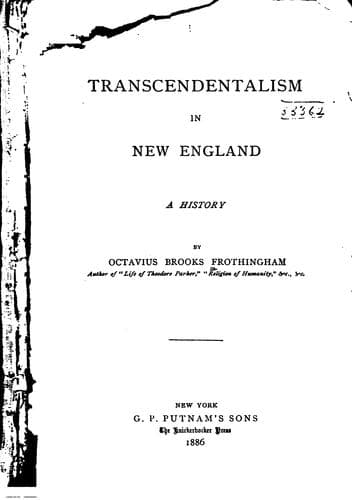
Transcendentalism in New England: A HistoryFrothingham, Octavius Brooks
Philosophy
Transcendentalism in New England: A History
Frothingham, Octavius Brooks
Transcendentalism (New England)
The poetry of William Ellery Channing has a recognized place in American
literature, though much of it has disappeared. Dana's "Household Book of
Poetry" contains a single piece of his on "Death," that is characterized
by a depth of sentiment and a richness of expression, which his more
distinguished contemporary, Mr. Bryant, does not surpass. Mr. Emerson's
"Parnassus" contains eight, the last of which, entitled "A Poet's Hope,"
closes with the wonderful line--
"If my bark sink, 'tis to another sea."
Of Cranch's poems, several have been adopted by collectors,--notably the
lines--
"Thought is deeper than all speech--
Feeling deeper than all thought;
Soul to soul can never teach
What unto itself was taught."
Weiss, Wasson, and Higginson are true artists in letters. The essays of
the last named of the three are the best known, partly by reason of
their greater popularity of theme; but Mr. Wasson's discussions on
ethical and philosophical subjects are distinguished by their luminous
quality. Except for the vein of unhopefulness--partly due to ill
health--that pervades them, the chill communicated by the regions he
sails by, three or four of them would, without hesitation, be classed
among the gems of speculative literature. The best work of Weiss, his
lectures on the Greek Ideas for example, stands apart by itself, perhaps
unrivalled as an attempt to unveil the glory of the ancient mythology.
The interpretation of religious symbols is his province, where, by the
power of "sympathetic perception,"--to use Mr. Wasson's fine phrase--he
penetrates the secret of mysteries, and brings the soul of dark enigmas
to the light; and his beauty of expression more than restores to the
imagination the splendors which the unpoetic interpreter reduces to
meretricious fancy.
The influence of Transcendentalism on pulpit literature--if there be
such a thing--has probably been sufficiently indicated; but the
privilege of printing a sermon of Mr. Emerson's--the only one ever
published, the famous one, that was the occasion of his leaving the
ministry and adopting the profession of literature--affords opportunity
for a special illustration. The sermon--which is interesting in itself,
from the subject, the occasion that called it forth, the insight it
gives into Mr. Emerson's mind and character--is interesting as an
example of the method and spirit which Transcendentalism introduced into
discussions that are usually dry and often angry.
The Kingdom of God is not meat and drink, but righteousness, and
peace, and joy in the Holy Ghost.--ROMANS XIV. 17.
Public-domain text, read in full here on John Shaqi.
Reviews
Reviews
No reviews yet
Be the first to share your thoughts on this work.
Elsewhere in the archive
Join the Discussion
Join the discussion
Sign in to leave a comment or review.
Sign InorCreate an account