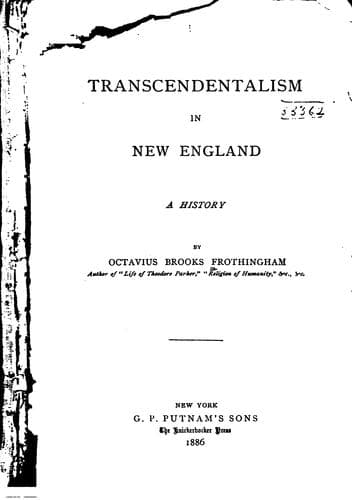
Transcendentalism in New England: A HistoryFrothingham, Octavius Brooks
Philosophy
Transcendentalism in New England: A History
Frothingham, Octavius Brooks
Transcendentalism (New England)
In the history of the Church no subject has been more fruitful of
controversy than the Lord's Supper. There never has been any unanimity
in the understanding of its nature, nor any uniformity in the mode of
celebrating it. Without considering the frivolous questions which have
been lately debated as to the posture in which men should partake of it;
whether mixed or unmixed wine should be served; whether leavened or
unleavened bread should be broken; the questions have been settled
differently in every church, who should be admitted to the feast, and
how often it should be prepared. In the Catholic Church, infants were at
one time permitted and then forbidden to partake; and, since the ninth
century, the laity receive the bread only, the cup being reserved to the
priesthood. So, as to the time of the solemnity. In the fourth Lateran
Council, it was decreed that any believer should communicate at least
once in a year--at Easter. Afterwards it was determined that this
Sacrament should be received three times in the year--at Easter,
Whitsuntide, and Christmas. But more important controversies have arisen
respecting its nature. The famous question of the Real Presence was the
main controversy between the Church of England and the Church of Rome.
The doctrine of the Consubstantiation taught by Luther was denied by
Calvin. In the Church of England, Archbishops Laud and Wake maintained
that the elements were an Eucharist or sacrifice of Thanksgiving to God;
Cudworth and Warburton, that this was not a sacrifice, but a sacrificial
feast; and Bishop Hoadley, that it was neither a sacrifice nor a feast
after sacrifice, but a simple commemoration. And finally, it is now near
two hundred years since the Society of Quakers denied the authority of
the rite altogether, and gave good reasons for disusing it.
I allude to these facts only to show that, so far from the supper being
a tradition in which men are fully agreed, there has always been the
widest room for difference of opinion upon this particular.
Having recently given particular attention to this subject, I was led to
the conclusion that Jesus did not intend to establish an institution for
perpetual observance when he ate the Passover with his disciples; and,
further, to the opinion, that it is not expedient to celebrate it as we
do. I shall now endeavor to state distinctly my reasons for these two
opinions.
I. The authority of the rite.
An account of the last supper of Christ with his disciples is given by
the four Evangelists, Matthew, Mark, Luke, and John.
In St. Matthew's Gospel (Matt. XXVI. 26-30) are recorded the words of
Jesus in giving bread and wine on that occasion to his disciples, but
no expression occurs intimating that this feast was hereafter to be
commemorated.
In St. Mark (Mark XIV. 23) the same words are recorded, and still with
no intimation that the occasion was to be remembered.
Public-domain text, read in full here on John Shaqi.
Reviews
Reviews
No reviews yet
Be the first to share your thoughts on this work.
Elsewhere in the archive
Join the Discussion
Join the discussion
Sign in to leave a comment or review.
Sign InorCreate an account