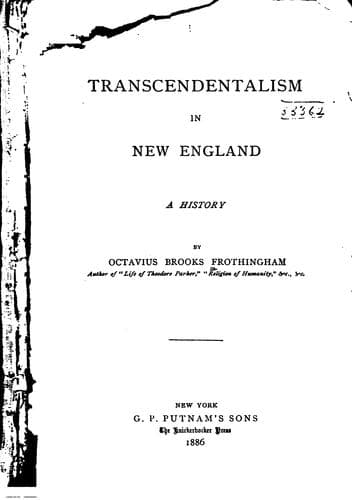
Transcendentalism in New England: A HistoryFrothingham, Octavius Brooks
Philosophy
Transcendentalism in New England: A History
Frothingham, Octavius Brooks
Transcendentalism (New England)
St. Luke (Luke XXII. 15), after relating the breaking of the bread, has
these words: This do in remembrance of me.
In St. John, although other occurrences of the same evening are related,
this whole transaction is passed over without notice.
Now observe the facts. Two of the Evangelists, namely, Matthew and John,
were of the twelve disciples, and were present on that occasion. Neither
of them drops the slightest intimation of any intention on the part of
Jesus to set up anything permanent. John, especially, the beloved
disciple, who has recorded with minuteness the conversation and the
transactions of that memorable evening, has quite omitted such a notice.
Neither does it appear to have come to the knowledge of Mark who, though
not an eye-witness, relates the other facts. This material fact, that
the occasion was to be remembered, is found in Luke alone, who was not
present. There is no reason, however, that we know, for rejecting the
account of Luke. I doubt not, the expression was used by Jesus. I shall
presently consider its meaning. I have only brought these accounts
together, that you may judge whether it is likely that a solemn
institution, to be continued to the end of time by all mankind, as they
should come, nation after nation, within the influence of the Christian
religion, would have been established in this slight manner in a manner
so slight, that the intention of commemorating it should not appear,
from their narrative, to have caught the ear or dwelt in the mind of the
only two among the twelve who wrote down what happened.
Still we must suppose that the expression, "_This do in remembrance of
me_," had come to the ear of Luke from some disciple who was present.
What did it really signify? It is a prophetic and an affectionate
expression. Jesus is a Jew, sitting with his countrymen, celebrating
their national feast. He thinks of his own impending death, and wishes
the minds of his disciples to be prepared for it. "When hereafter," he
says to them, "you shall keep the Passover, it will have an altered
aspect to your eyes. It is now a historical covenant of God with the
Jewish nation. Hereafter, it will remind you of a new covenant sealed
with my blood. In years to come, as long as your people shall come up to
Jerusalem to keep this feast, the connection which has subsisted between
us will give a new meaning in your eyes to the national festival, as the
anniversary of my death." I see natural feeling and beauty in the use of
such language from Jesus, a friend to his friends; I can readily imagine
that he was willing and desirous, when his disciples met, his memory
should hallow their intercourse; but I cannot bring myself to believe
that in the use of such an expression he looked beyond the living
generation, beyond the abolition of the festival he was celebrating,
and the scattering of the nation, and meant to impose a memorial feast
upon the whole world.
Public-domain text, read in full here on John Shaqi.
Reviews
Reviews
No reviews yet
Be the first to share your thoughts on this work.
Elsewhere in the archive
Join the Discussion
Join the discussion
Sign in to leave a comment or review.
Sign InorCreate an account