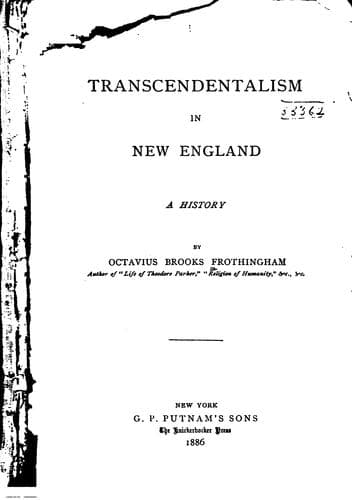
Transcendentalism in New England: A HistoryFrothingham, Octavius Brooks
Philosophy
Transcendentalism in New England: A History
Frothingham, Octavius Brooks
Transcendentalism (New England)
Its institutions, then, should be as
flexible as the wants of men. That form out of which the life and
suitableness have departed, should be as worthless in its eyes as the
dead leaves that are falling around us.
And therefore, although for the satisfaction of others, I have labored
to show by the history that this rite was not intended to be perpetual;
although I have gone back to weigh the expressions of Paul, I feel that
here is the true point of view. In the midst of considerations as to
what Paul thought, and why he so thought, I cannot help feeling that it
is time misspent to argue to or from his convictions, or those of Luke
and John, respecting any form. I seem to lose the substance in seeking
the shadow. That for which Paul lived and died so gloriously; that for
which Jesus gave himself to be crucified; the end that animated the
thousand martyrs and heroes who have followed his steps, was to redeem
us from a formal religion, and teach us to seek our well-being in the
formation of the soul. The whole world was full of idols and ordinances.
The Jewish was a religion of forms. The Pagan was a religion of forms;
it was all body--it had no life--and the Almighty God was pleased to
qualify and send forth a man to teach men that they must serve him with
the heart; that only that life was religious which was thoroughly good;
that sacrifice was smoke, and forms were shadows. This man lived and
died true to this purpose; and now, with his blessed word and life
before us, Christians must contend that it is a matter of vital
importance--really a duty, to commemorate him by a certain form, whether
that form be agreeable to their understandings or not.
Is not this to make vain the gift of God? Is not this to turn back the
hand on the dial? Is not this to make men--to make ourselves--forget
that not forms, but duties; not names, but righteousness and love are
enjoined; and that in the eye of God there is no other measure of the
value of any one form than the measure of its use?
There remain some practical objections to the ordinance into which I
shall not now enter. There is one on which I had intended to say a few
words; I mean the unfavorable relation in which it places that numerous
class of persons who abstain from it merely from disinclination to the
rite.
Influenced by these considerations, I have proposed to the brethren of
the Church to drop the use of the elements and the claim of authority in
the administration of this ordinance, and have suggested a mode in which
a meeting for the same purpose might be held free of objection.
Public-domain text, read in full here on John Shaqi.
Reviews
Reviews
No reviews yet
Be the first to share your thoughts on this work.
Elsewhere in the archive
Join the Discussion
Join the discussion
Sign in to leave a comment or review.
Sign InorCreate an account