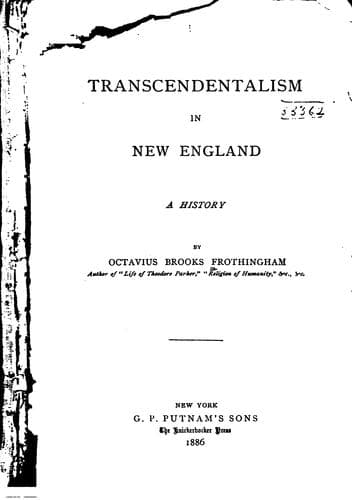
Transcendentalism in New England: A HistoryFrothingham, Octavius Brooks
Philosophy
Transcendentalism in New England: A History
Frothingham, Octavius Brooks
Transcendentalism (New England)
My brethren have considered my views with patience and candor, and have
recommended unanimously an adherence to the present form. I have,
therefore, been compelled to consider whether it becomes me to
administer it. I am clearly of opinion I ought not. This discourse has
already been so far extended, that I can only say that the reason of my
determination is shortly this:--It is my desire, in the office of a
Christian minister, to do nothing which I cannot do with my whole heart.
Having said this, I have said all. I have no hostility to this
institution; I am only stating my want of sympathy with it. Neither
should I ever have obtruded this opinion upon other people, had I not
been called by my office to administer it. That is the end of my
opposition, that I am not interested in it. I am content that it stand
to the end of the world, if it please men and please heaven, and I shall
rejoice in all the good it produces.
As it is the prevailing opinion and feeling in our religious community,
that it is an indispensable part of the pastoral office to administer
this ordinance, I am about to resign into your hands that office which
you have confided to me. It has many duties for which I am feebly
qualified. It has some which it will always be my delight to discharge,
according to my ability, wherever I exist. And whilst the recollection
of its claims oppresses me with a sense of my unworthiness, I am
consoled by the hope that no time and no change can deprive me of the
satisfaction of pursuing and exercising its highest functions.
September 9, 1832.
* * * * *
The influence of Transcendentalism on general literature can be only
indicated in loose terms. Its current was so strong, that like the
Orinoco rushing down between the South American continent and the island
of Trinidad, it made a bright green trail upon the dark sea into which
it poured, but the vehemence of the flood forbade its diffusion. The
influence was chiefly felt on the departments of philosophy and ethics.
It created the turbulent literature of reform, the literature born of
the "Enthusiasm of Humanity," the waves whereof are still rolling,
though not with their original force. The literature of politics was
profoundly affected by it; the political radicals, philosophical
democrats, anti-slavery whigs or republicans, enthusiasts for American
ideas, prophets of America's destiny, being, more or less wittingly,
controlled by its ideas. In this department Parker made himself felt,
not on the popular mind alone, but on the recognized leaders of opinion
East and West. The writings of Sumner and his school owe their vigor to
these ideas. In history Bancroft was its great representative, his
earliest volumes especially revealing in the richness, depth, and
hopefulness of their interpretations of men and measures, the faith in
humanity so strongly characteristic of the philosophy he professed.
Public-domain text, read in full here on John Shaqi.
Reviews
Reviews
No reviews yet
Be the first to share your thoughts on this work.
Elsewhere in the archive
Join the Discussion
Join the discussion
Sign in to leave a comment or review.
Sign InorCreate an account