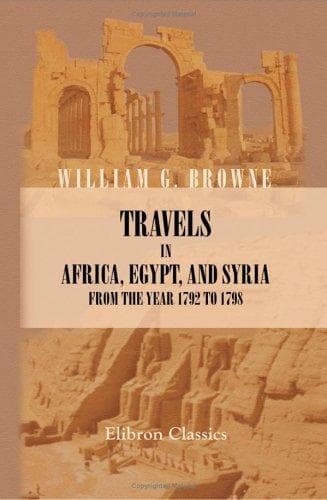
Travels in Africa, Egypt, and Syria, from the year 1792 to 1798 — John Shaqi
Travels in Africa, Egypt, and Syria, from the year 1792 to 1798Browne, William George
History
Travels in Africa, Egypt, and Syria, from the year 1792 to 1798
Browne, William George
Egypt -- Description and travel; Sudan -- Description and travel; Syria -- Description and travel
We left our apartment at day-break, before any great number of people
was assembled; and having taken with me such instruments as I was
provided with, we passed along some shady paths, between the gardens,
till at the distance of about two miles we arrived at what they
called the ruins, or _birbé_. I was greatly surprised at finding
myself near a building of undoubted antiquity, and, though small,
in every view worthy of remark. It was a single apartment, built of
massy stones, of the same kind as those of which the pyramids consist;
and covered originally with six large and solid blocks, that reach
from one wall to the other. The length I found thirty-two feet in the
clear; the height about eighteen, the width fifteen. A gate, situated
at one extremity, forms the principal entrance; and two doors, also
near that extremity, open opposite to each other. The other end is
quite ruinous; but, judging from circumstances, it may be imagined
that the building has never been much larger than it now is. There
is no appearance of any other edifice having been attached to it,
and the less so as there are remains of sculpture on the exterior of
the walls. In the interior are three rows of emblematical figures,
apparently designed to represent a procession: and the space between
them is filled with hieroglyphic characters, properly so called. The
soffit is also adorned in the same manner, but one of the stones which
formed it is fallen within, and breaks the connection. The other
five remain entire. The sculpture is sufficiently distinguishable;
and even the colours in some places remain. The soil around seems
to indicate that other buildings have once existed near the place;
the materials of which either time has levelled with the soil, or
the natives have applied to other purposes. I observed, indeed,
some hewn stones wrought in the walls of the modern buildings,
but was unable to identify them by any marks of sculpture.
It was mentioned to me that there were many other ruins near; but
after walking for some time where they were described to be, and
observing that they pointed out as ruins what were in fact only rough
stones, apparently detached from the rock, I returned fatigued and
dissatisfied. The Shechs had provided for us a dinner in a garden,
where we were unmolested by intruders; and the sun being then near
the meridian, I took the opportunity of observing its altitude by
means of an artificial horizon. They who are best versed in these
matters will be far from thinking this the most accurate method of
determining the latitude. But the result was not materially different,
though in the sequel I repeated my observation. It gave N. L. 29°
12′, and a fraction:—the long. E. F. 44° 54′.
Public-domain text, read in full here on John Shaqi.
Reviews
Reviews
No reviews yet
Be the first to share your thoughts on this work.
Join the Discussion
Join the discussion
Sign in to leave a comment or review.
Sign InorCreate an account