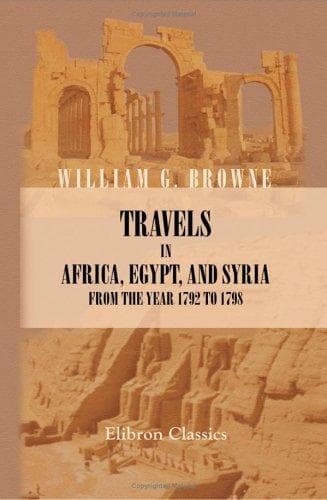
Travels in Africa, Egypt, and Syria, from the year 1792 to 1798Browne, William George
History
Travels in Africa, Egypt, and Syria, from the year 1792 to 1798
Browne, William George
Egypt -- Description and travel; Sudan -- Description and travel; Syria -- Description and travel
An innovation as to the orthography of some proper names, it is
supposed, will not appear affected or improper, when the reason is
explained; as _Kahira_, _Damiatt_, _Rashîd_, for _Cairo_, _Damietta_,
_Rosetto_. It is of some use in appellatives to approximate to the
pronunciation of the natives, and there can be as little reason
for receiving Arabic names through the medium of the Italian, as
for adopting the French way of writing Greek ones, as _Denys_ for
_Dionysius_, and _Tite-Live_ for Titus Livius. Kahira and Rashîd
have each of them their proper meaning in Arabic.—In Italian they
have no meaning. The only rule observed has been, to bring back
proper names to the original pronunciation, as far as might be done
without obscurity.
Where a circumflex has been put over a vowel it is to denote its
length, or something exotic in the enunciation. An approach to
systematic regularity would have been attempted in expressing Arabic
words by Roman letters, but the author freely owns that no rule, at
once general in its use and simple and easy enough to be remembered,
has yet occurred to him. He has therefore added the original word,
wherever it could in any degree tend to illustration or precision.
The word _Turk_ is never applied to signify a professor of
Mohammedism, an indefinite mode of designation, that occasions
perpetual confusion in speaking of the affairs of the East. The
design was, to confine that term to the natives of Europe and Asia
Minor. _Arab_ is applied equally to the inhabitants of Syria, Egypt,
and the coast of Barbary, as well as to those of Arabia Proper,
whether villagers or wanderers. The wandering tribes are however
more frequently marked by the terms _Bedouin_ and _Muggrebin_.
The orthography of the word _Calif_ conveys no idea of the strong
guttural letter with which it commences; it is therefore here written
_Chalîf_, or more properly _Chalifé_. He is no stranger to the
Turkish word _Bek_ or _Beg_; but as those whose enunciation of
that language is esteemed most correct, but faintly articulate the
consonant which terminates it, he has retained the common orthography
_Bey_. In general, the original language is esteemed the criterion
of spelling; and if the same word be occasionally spelled in two
different ways, it is only because they are both equally near to
that original.
_Weights and Measures._
One _oke_ of Kahira = four hundred drams.
One _rotal_ = one hundred forty-four drams.
One _rotal_ silk of Syria = two hundred twenty-nine and a half
drams.
The Cantar is rotals = 102 — 105 — 110 — 120 — 130,
variable according to the commodity.
_Jewels, Gold, and Silver._
One kerât = 4 grains.
One dram or dirhem = 16 kerâts.
One mitkâl = 24 kerâts.
One wekîé = 8¼ drams.
_Measure of Cloth, &c._
Public-domain text, read in full here on John Shaqi.
Reviews
Reviews
No reviews yet
Be the first to share your thoughts on this work.
Join the Discussion
Join the discussion
Sign in to leave a comment or review.
Sign InorCreate an account