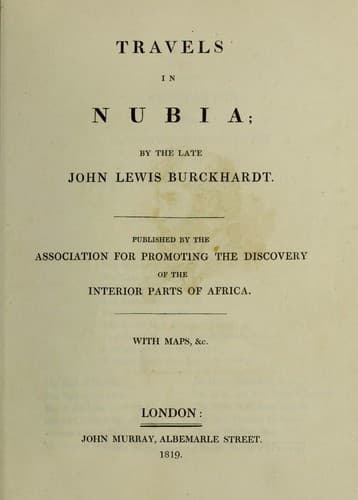
Burckhardt, John Lewis, 1784-1817; Nile River Valley -- Description and travel; Nubia -- Description and travel
The slave caravan from Mahass, which I mentioned above, passed along
the west bank of the river, while I was at Eshke; the usual route
of these caravans, which generally visit Egypt twice in the year,
lies across the desert, from Mahass to the Great Oasis, a journey of
twenty-three days; and from thence to Siout and Cairo. It was only
this year that the slave-traders, informed of the perfectly tranquil
state of Nubia and Upper Egypt, had ventured to proceed along the
banks of the Nile, a road they had not followed in the memory of man.
To the south of Eshke is a sandy plain; in three hours, we
reached Dabrous (دَبروس); the direction of the road S. W. by
S. Four hours, Sukoy (سَقوي). Five hours, Wady Halfa (وادي
حلفه), to the east of which, the eastern mountain terminates in
slight undulations of the ground; but these increase in size, and
collect again into mountains, about thirty miles farther up. There
is some trade carried on at Wady Halfa; vessels from Assouan often
moor here to load dates, and the nitre which the Arabs collect at
three days journeys from hence in the western desert.[29] In summer,
the navigation from Derr to Wady Halfa becomes, in many places,
very difficult, except for small boats, on account of the sand
banks. One of the relations of the governors of Nubia resides here,
and collects the revenue.
At the end of six hours, we came to the southern extremity of Wady
Halfa. The river forms here several islands, upon one of which are
the remains of an ancient town, built of bricks, with a high brick
wall. Seven hours, the plain over which we rode became uneven,
and studded with insulated clusters of rocks, whose summits just
appear above the surface of the sand. To the west is the second
Cataract. Eight hours, halted for the night, in this desert,
near one of the islands, which are formed by the river. The noise
of the Cataract was heard in the night, at about half an hour’s
distance. The place is very romantic; when the inundation subsides,
many small lakes are left among the rocks; and the banks of these,
overgrown with large tamarisks, have a picturesque appearance amidst
the black and green rocks; the lakes and pools thus formed cover a
space of upwards of two miles in breadth. I here shot a wild-goose,
which afforded a supper to our party, now increased by the company
of a poor young girl from Dabrous, who ran after us, when she saw
us pass by, and begged we would take her under our protection as far
as Wady Mershed, beyond the Cataract. From Wady Halfa to Sukkot is a
stony wilderness, with many cataracts in the river, similar to that
at Assouan; and the navigation is interrupted for about one hundred
miles. This rocky tract is called Dar el Hadjar, or Batn el Hadjar,
i. e. the rocky district, or the “womb of rocks.”
Public-domain text, read in full here on John Shaqi.
Reviews
Reviews
No reviews yet
Be the first to share your thoughts on this work.
Elsewhere in the archive
Join the Discussion
Join the discussion
Sign in to leave a comment or review.
Sign InorCreate an account