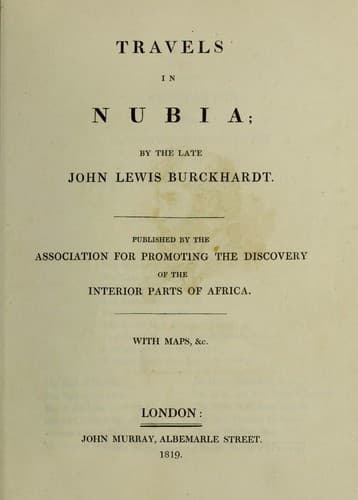
Burckhardt, John Lewis, 1784-1817; Nile River Valley -- Description and travel; Nubia -- Description and travel
_March 7th._ After a march of one hour, the straggling hillocks and
mounds rose into a low chain of hills, the road amongst them being
a perfect sandy plain. In one hour and a half we came to Wady Amka
(وادي عَمقه). In the Batn el Hadjar, there occur a few
spots that admit of cultivation; but they consist of very narrow
strips of plain by the side of the river, where the banks are
generally so high, that the waters do not reach them during the
inundation, and where the soil must consequently be irrigated,
by means of water-wheels. These narrow plains, called Wady, as in
other parts of the country, were formerly well cultivated. Their
principal inhabitants pretend to be Sherifs from Mekka, and to have
come here at the time of the invasion of the other Arab tribes.
They have a chief named Abdallah Ibn Emhyd
(عبدالّه ابن امهيد), who resides in Wady Attar,[30]
and is honoured with the title of Melek, or king, which is bestowed
on chiefs of all ranks from hence southward. These Sherifs, called
Omsherif (اُم شريف), pay a small tribute to their Melek, and
the Melek is tributary to the governors of Nubia, who besides carry
off as much of the property of these Arabs as falls in their way,
whenever they pass along the Batn el Hadjar. The greater part of
the Sherifs, however, have now quitted their abode, owing to the
continued incursions of the Arabs Sheygya (شَيِكيعَ), who
live on the banks of the river, south of Dongola, eight days journeys
distant from Sukkot, across the desert; and whose depredations
have so much ruined the Sherifs, that the greater part of them
have retired to Sukkot, and many of them to Dongola. At present,
the male inhabitants in the whole district of Batn el Hadjar hardly
amount to two hundred, half of whom are Sherifs, and the other of
the Bedouin tribe of Kerrarish. Some Arabs remain at Amka; and a
small village is built upon a rocky island, where are the ruins of
a large brick tower; from hence the Arabs cross the branch of the
river every morning, (upon the trunk of a palm-tree, using their
hands as paddles) for the purpose of cultivating their fields
upon the shore, and return in the evening in the same manner. As
we advance the river continues to be full of rocks and islands,
and the country has a very wild aspect. There is no place that so
much resembles the Batn el Hadjar and its Wadys, as the road along
the Nile from Assouan to the first Cataract; the same rocky shore,
with here and there the same narrow strip of soil, continues all
along “the womb of rocks,” from Wady Halfa to Sukkot.
Public-domain text, read in full here on John Shaqi.
Reviews
Reviews
No reviews yet
Be the first to share your thoughts on this work.
Elsewhere in the archive
Join the Discussion
Join the discussion
Sign in to leave a comment or review.
Sign InorCreate an account