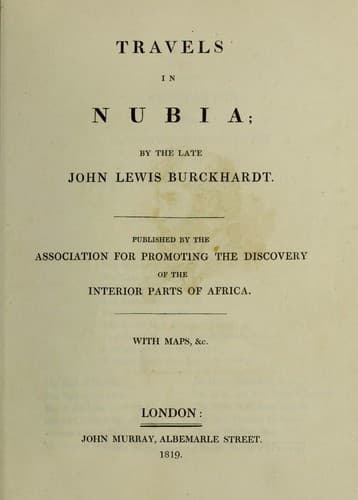
Burckhardt, John Lewis, 1784-1817; Nile River Valley -- Description and travel; Nubia -- Description and travel
At two hours and a half, is Wady Mershed (مرشد). The Wadys
are separated from each other by rocky tracts, which reach close
to the river. At Wady Mershed there are again numerous islands in
the river; upon two of them are some brick ruins, an ancient tower,
and a few huts of Arabs. Our route from Wady Halfa to Mershed had
been W. S. W. Above Mershed, the river is free from islands, and
few rocks are seen in it; but its bed is very narrow, and the banks
are high: I could throw a stone over to the opposite side. Four
hours and a half brought us to Sette Hadje, a cultivable patch of
ground, enclosed by rocks, with some ancient brick dwellings; it
is inhabited only by an old Arab, who lives in the hut constructed
over the tomb of the female saint called Sette Hadje, and who owes
his livelihood to the charity of passengers: I found him extended
upon his mat, with a pot of water, and an earthen vessel near him,
into which I put a few handfuls of dates. From hence southwards,
the river has many windings. The hills on the east side increase
in height until eight hours and a half, at Wady Seras (سِراص),
when they again form a regular chain of mountains, over which lies
the road from Wady Sette Hadje. My old Arab guide, afraid of robbers
from among the Sheygya Arabs, who are continually hovering about in
these parts, to waylay travellers, hurried me along as fast as he
could. We met very few persons on the road, excepting small parties
of five or six Soudan pilgrims, or Tekayrne (sing. Tekroury); these
courageous travellers come from all parts of Soudan to Darfour,
from whence they proceed either by Kardofan to Sennaar, or direct
to Dongola. From the Nile some of them take the route of Suakin,
crossing the Red Sea, from thence to Djidda; others follow the Nile
through Dongola and Mahass, and perform their pilgrimage with the
Egyptian Hadjis, after having remained some time in the mosque El
Azhar at Cairo, occupied in reading the Coran and a few books of
prayers. I found, upon subsequent enquiry, that the greater part of
these pilgrims were natives of Darfour, and Bergho. Among more than
forty whom I spoke to at Esne, I could not find one whose country
was as far west as Kashna; but I met with several who came from
Wangara. The name Tekroury is given to them, I suppose, from their
being natives of the district of Tekrour in Soudan. Such of them
as can read and write are called Fókara (plur. of Fakyr), a term
applied in Upper Egypt to all learned persons, by which is meant,
such as can read the Coran, and who know how to write talismans,
for preservatives against charms, and spells of the devil.
Public-domain text, read in full here on John Shaqi.
Reviews
Reviews
No reviews yet
Be the first to share your thoughts on this work.
Elsewhere in the archive
Join the Discussion
Join the discussion
Sign in to leave a comment or review.
Sign InorCreate an account