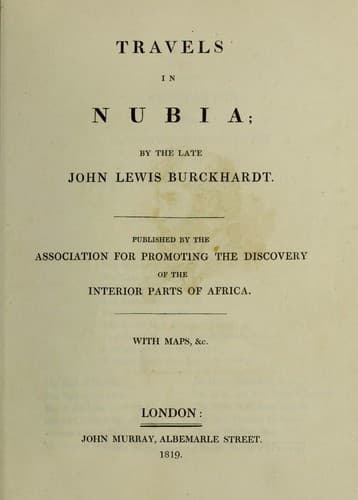
Burckhardt, John Lewis, 1784-1817; Nile River Valley -- Description and travel; Nubia -- Description and travel
Nine hours and a half, we stopped at the southern extremity of Wady
Seras, at a hut of Kerrarish Arabs, who, together with a family
of the Sherifs, were watching the produce of a few cotton fields,
and bean plantations. They gave us some milk for supper, assuring
us that they had no bread, and that they had not even tasted any for
the last two months. I distributed a measure of Dhourra amongst them,
upon condition that they should not exchange it for any thing else,
but make bread of it for themselves and their women, for the latter
very seldom enjoy this luxury, which is almost exclusively reserved
for their husbands and brothers. In consequence of my present,
the women were all set to work to grind the Dhourra between two
granite stones, for the richer class only have hand-mills (رحا),
like those of the Arabian Bedouins. Plenty of bread was then made,
and the girls sat up, eating and singing, the whole of the night,
and being separated from us only by a partition formed of tamarisk
branches, they often joined in the conversation. The leaves
of beans, and the grain of the shrub Kerkedan, which is black,
and resembles in size the coriander seed, form the food of these
people. The Kerkedan grows wild in the Batn el Hadjar, and is sown
in some parts of Northern Nubia; a coffee is made from the roasted
grains, which is not disagreeable to the taste, but the Arabs more
usually make bread of them. The leguminous shrub Symka is also very
common here, and affords excellent food for camels; it produces a
pod, resembling pease, and containing several round rose coloured
grains, which are edible, when green; these the Arabs collect and
dry, and by hard boiling, obtain from them an oil, which they use,
instead of butter, to grease their hair and body.
The Sherifs of Batn el Hadjar are of the darkest brown colour, with
fine features, and are remarkably well made. Both men and women go
naked; but the latter wear leather amulets round the neck, copper
armlets and bracelets, and silver ear-rings. Most of them speak a
little Arabic.
Public-domain text, read in full here on John Shaqi.
Reviews
Reviews
No reviews yet
Be the first to share your thoughts on this work.
Elsewhere in the archive
Join the Discussion
Join the discussion
Sign in to leave a comment or review.
Sign InorCreate an account