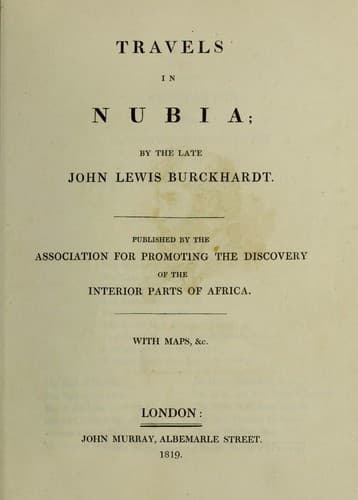
Burckhardt, John Lewis, 1784-1817; Nile River Valley -- Description and travel; Nubia -- Description and travel
rocky desert, where the eye, fatigued by the view of the dreary
wilderness, searches with difficulty for the blue stream, often
hidden by islands, and only appearing partially. Its course from
hence is S. W. by S. At seven hours, we descended from the mountain
into Wady Ambigo (اَمبقُو). At eight hours, were several
cataracts, where the stream rushes impetuously over the rocks,
and carries its foaming current to the distance of several hundred
feet; there is no where, however, any fall, that can be properly
so called. All these cataracts resemble those of Assouan, but the
river is more narrowly hemmed in by rocks than at the latter place;
and its whole course through the Batn el Hadjar is so very rapid,
that navigation of every kind seems to be quite impracticable. At
the end of nine hours, we stopped at a hut of Omsherifs.
_March 9th._ To the east of Ambigo, there are high mountains;
and to the south of it, the eastern chain decreases in height. The
mountains of Ambigo seem to be the highest summit of the Batn el
Hadjar. Our road lay alternately along the shore, and over the
rocks; I no where saw any traces of an ancient road through this
rugged district. In three hours we reached Wady Om Kanaszer (اُم
قناَصِر), in which is a small watch-tower built of stones,
upon a hill. From hence we followed a mountainous road as far as Wady
Lamoule (وادي لاموله), which we reached in five hours;
here are some cataracts in the river, and several rocky islands,
upon which I saw crocodiles basking. At five hours and a half,
we ascended the mountain; and in six hours gained a high summit,
known by the name of Djebel Lamoule (جبل لامولَه), and
corresponding with a similar one on the west side. At the foot of
this hill, the Arabs repeat the custom of digging the traveller’s
grave, but as I knew not how often a present might in this way be
demanded of me by my guide, I refused to give him any thing upon his
making the demand; and as soon as he began to construct my tomb,
I alighted, and making another, told him that it was intended for
his own sepulture; for that, as we were brethren, it was but just
that we should be buried together. At this, he began to laugh;
we then mutually destroyed each other’s labours, and in riding
along he exclaimed from the Coran, “No mortal knows the spot upon
earth where his grave shall be digged.” Seven hours brought us to
a sandy plain in the mountain, called Khor Sonk (خور سُنك),
Sonk being a Wady, situated below it. As the road which leads to the
country of the Sheygya turns off here, this spot is more frequently
visited by them, than any other part of this rocky tract, and is
noted for the many robberies committed here by those Arabs; my guide
shewed me the place where his cousin had been killed, at his side, in
an encounter with the Sheygya, and hurried me, at a full trot, over
the plain. The whole of the Batn el Hadjar is dangerous for single
travellers; but it was my good fortune not to meet with any banditti;
Public-domain text, read in full here on John Shaqi.
Reviews
Reviews
No reviews yet
Be the first to share your thoughts on this work.
Elsewhere in the archive
Join the Discussion
Join the discussion
Sign in to leave a comment or review.
Sign InorCreate an account