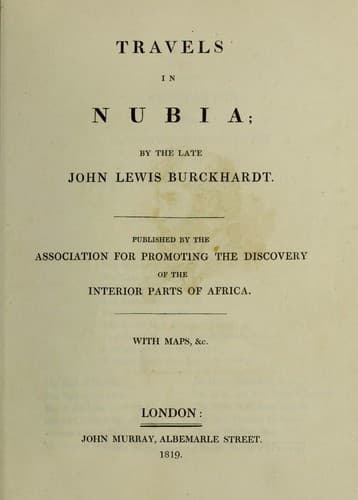
Burckhardt, John Lewis, 1784-1817; Nile River Valley -- Description and travel; Nubia -- Description and travel
to write a few lines for me upon a blank corner of an old letter,
the only paper that could be found. He repeatedly enquired my
business; I answered, that I was the bearer of letters from Esne
to the two Kashefs, who were at Mahass. After a stay of one hour
I retired, recrossed the river, and continued my journey. We rode
over mountainous ground, where the sand-stone again appears among
the grauwacke and feldspath, until, at two hours and a half from
Kolbe, we reached Wady Dal (وادي دال), which may be called
the southern extremity of the Batn el Hadjar. At Dal the river
is interrupted by immense blocks of granite lying confusedly
across it, occasioning several foaming cataracts, and forming
many rocky islands; upon one of these is a large brick building,
in ruins. Here the country opens, and we continued for half an hour
along a cultivable shore, overgrown with date trees, amongst which
was a ruined village, called Dabbe. One hour farther, still following
the plain by the side of the river, we arrived at the village of
Zergamotto (زرقَمطو), where we slept. The inhabitants of
Zergamotto bring rock salt from Selyma, distant two long days and
a half in the western desert, and a halting-place of the Darfour
caravan, in its way to Siout. Whenever this caravan passes Selyma,
the Nubians resort thither, to sell dates and other provisions to
the travellers. Rock salt is found also in every part of the eastern
mountain from Kenne southward, and the peasants of Egypt and Nubia
collect it; but it has a very disagreeable bitterish-sweet taste.
_March 11th._ From Dabbe our road lay S. by W. We rode along the
bank of the river; where the plain is about two miles in breadth,
but for the greater part barren. The river continues to be full of
low islands, and rocks. In one hour and a half we came to a cluster
of small hamlets, called Ferke (فرقه). In the plain are five
barrows, or tumuli, evidently artificial, like those I saw near
Kosko.[33] The son of the governor of Sukkot, to whom I had the
letter of recommendation, lives upon an island at Ferke. We stopped
opposite the island to bait our camels upon the tamarisk trees;
and as this place, according to the injunction of Hassan Kashef,
was to be the termination of my journey southwards, and the farthest
point to which my guide was to conduct me, the latter insisted
upon complying with the orders of his master. A promise, however,
of two piastres and a woollen Melaye, worth as much, overcame his
fidelity, and he agreed to accompany me to Mahass; “If Hassan
Kashef,” said he, “upbraids me, I shall tell him that you rode
on, notwithstanding my exhortations, and that I did not think it
honourable to leave you alone.” My plan was, to reach Tinareh,
the chief place in Mahass, and there to cross over to the western
side, as I knew that the Kashefs, who were encamped there, had a
vessel at their disposal. On my way back, I intended to visit Say,
and all the ruins on the western side.
Public-domain text, read in full here on John Shaqi.
Reviews
Reviews
No reviews yet
Be the first to share your thoughts on this work.
Elsewhere in the archive
Join the Discussion
Join the discussion
Sign in to leave a comment or review.
Sign InorCreate an account