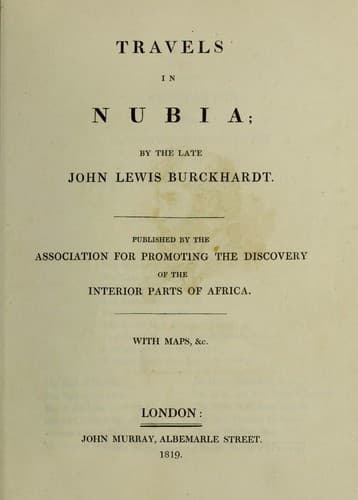
Burckhardt, John Lewis, 1784-1817; Nile River Valley -- Description and travel; Nubia -- Description and travel
_March 18th._ Our road lay over a high sandy plain, in the
direction of E. by N.; insulated rocky hills rise above the
plain, and form a hilly chain, much inferior in height to the
mountains on the east side. At two hours the beginning of Wady
Formoke (وادي فرمكه), lay several miles to our right,
on the banks of the river. Three hours, Wady Om Kanaszer; here,
upon a rocky island, are several brick ruins, and a tower of
some size, of the same material. This place is inhabited by some
Omsherifs, who cultivate a few acres of ground; they begged a
little gunpowder of me to shoot the gazelles, which devour their
harvest. These animals inhabit the western mountains in large herds,
and regularly descend to the banks of the river during the night,
to feed upon the herbage which grows there; I every morning found
the sands above the river thickly covered with the traces of the
delicate feet of this pretty animal. The Arabs have no other means
of guarding their fields against them, than by setting up objects
to frighten them; I frequently met with the grotesque figure of a
hyena, formed of straw, and mounted upon legs of wood. The hyena
inhabits the mountains on both sides of the river, and is the most
formidable enemy of the gazelle. I did not hear of any other beasts
of prey in these parts. In five hours we came to Wady Ambigo, or
Ambougo, with large islands in the river. The high sandy plain,
with insulated hills, continues on this side; and the Nile has
many turnings. We always made a short cut over the mountain. Our
road from Ambigo lay E. N. E. until at eight hours and a half,
Wady Ambigo terminated; Djebel Doushe being on the eastern bank;
the road for the greater part lies over a plain covered with what
are called Egyptian pebbles; the mounds and hillocks on both sides
of the road consist, for about three miles, of red porphyry. Ten
hours, Wady Attyre, where we passed the house of the Melek of the
Omsherifs, built of stone: this, and several other habitations, had
been plundered and ruined last year by the Arabs Sheygya, who do not
confine their depredations to the eastern side, but often cross the
river, and lay waste the western shore. At ten hours and a half,
we halted for the night opposite the hut of a Kerrarish family,
who lived upon an island; they brought us some butter and milk,
and received Dhourra in exchange. In the night, a little girl came
over to us, and begged us to give her some Dhourra for her mother
and herself, as the men never allowed them any bread. I satisfied
her beyond her expectations; and early in the morning she returned
with a pot of milk, as a present from her mother. I should observe,
that my guide was known to this family, otherwise the girl would not
have trusted herself, alone, among entire strangers. The high thorny
shrub, called Syale (سياله) grows here in large quantities;
it bears red berries, which are eaten by the Arabs.
Public-domain text, read in full here on John Shaqi.
Reviews
Reviews
No reviews yet
Be the first to share your thoughts on this work.
Elsewhere in the archive
Join the Discussion
Join the discussion
Sign in to leave a comment or review.
Sign InorCreate an account