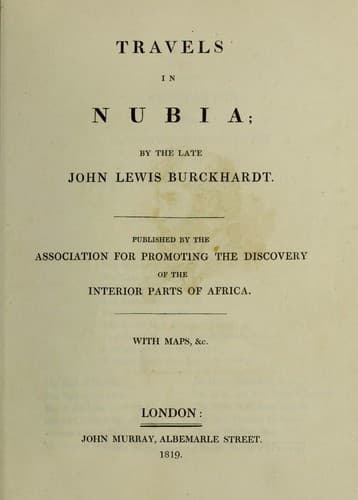
Burckhardt, John Lewis, 1784-1817; Nile River Valley -- Description and travel; Nubia -- Description and travel
The Berberys rear a large quantity of cattle, of the best kind,
which in winter and spring time, after the rains, is pastured
in the mountains of the Bisharein, where the keepers live like
Bedouins in huts and tents. During the latter part of the spring,
the cattle feed upon the wild herbs, which grow among the Dhourra
stubble as thickly as grass in a meadow. In summer time, when the
herbs are dried up, and there is scarcely any pasture upon the
mountains, they are fed at home with the dry stalks, and leaves of
the Dhourra. The principal riches of the shepherds consist in their
cows and camels. They have sheep and goats, but the greater part
having been consumed during the last famine, they are at present not
numerous. The cows are of a middling size, and not strongly built:
they have small horns, and upon the back, near the fore shoulder,
there is a hump of fat. This breed is unknown in Egypt; it begins
in Dóngola, and all along the Nile, as far as Sennaar, no others
are seen. The cows represented in the battle-pieces on the walls of
several ancient temples in Upper Egypt, have the same excrescence. I
saw the same species in the Hedjaz. Cows are kept for their milk,
but principally for their meat, and there are a few for the purpose
of turning the water-wheels.
The camels are of the best breed, much stronger, and more endured
to fatigue even than the celebrated breeds of Upper Egypt: their
dromedaries surpass all that I saw in the Syrian and Arabian
deserts. The camels have very short hair, and have no tufts on any
part of their body. The Hedjin or dromedary, is not of a different
species from the camel of burthen, but they are very careful of the
breed, and an Arab will undertake a journey of several days to have
his dromedary covered by a celebrated male. At present there is a
great demand for camels for the Egyptian market; they are bought
up by the Pasha to be sent to Arabia, for the transport of army
provisions, and every month three or four hundred are marched off
through the desert; yet a camel is worth here only from eight to
twelve dollars, though sold at Daraou for thirty or forty, and at
Cairo for fifty or sixty dollars.
Public-domain text, read in full here on John Shaqi.
Reviews
Reviews
No reviews yet
Be the first to share your thoughts on this work.
Elsewhere in the archive
Join the Discussion
Join the discussion
Sign in to leave a comment or review.
Sign InorCreate an account