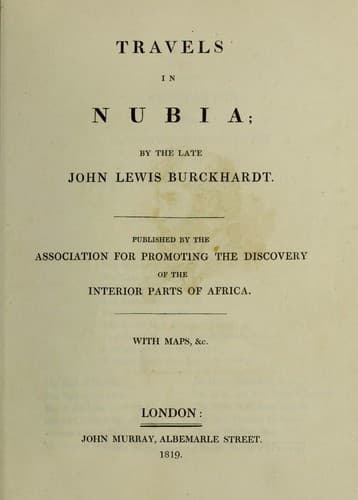
Burckhardt, John Lewis, 1784-1817; Nile River Valley -- Description and travel; Nubia -- Description and travel
The sheep of these southern countries have no wool, but are
covered with a thin short hair, resembling that of goats; hence
the inhabitants set little value upon them, and rear them for the
table only. Almost every family keeps two asses; they are of a
strong breed, and are employed chiefly to bring home the produce
of the fields, and transport the nitrous earth called Sabakha
(سَبَخه), which is procured in the mountain: the inhabitants
cover their fields with this earth, previously to sowing their seed,
but whether as manure, or as a corrective to the fatness of the soil,
I could not learn. Egyptian asses are much in demand, because they
run faster than the native; they are rode by the great people, and
are eagerly purchased on the arrival of every caravan. Horses are
numerous; every family of respectability keeping at least one, and
many two or three. The Arabs in the Nubian countries ride stallions
only. In their wars with their neighbours, the Meyrefab bring into
the field a considerable number of horsemen, who generally decide
the battle. The horses are of the Dóngola breed, which, as I have
already stated in my journey towards that country, is one of the
finest races in the world. They are fed upon Dhourra, and its dried
leaves serve instead of straw or hay: for several weeks in the spring
they are pastured in the green barley. A horse costs from fifteen
to forty dollars. They are not called Hoszan, as in Egypt, but Hafer
(حافِر). The saddles, which are of the same form as those used
in Dóngola, Sennaar, and Abyssinia, somewhat resemble those of the
European cavalry, having a high pommel in front, bending forward on
the horse’s neck. When entering on a campaign, the back, sides,
neck, and breast of the horses are covered with pieces of woollen
stuff, thickly quilted with cotton, which are said to be impenetrable
by the lance and sword; they are called Lebs (لِبْس), the name
given to a similar covering used by the Eastern Bedouins, but which
the Meyrefab work in a neater manner, and lighter, though stronger.
Almost all the people of Berber, who are cultivators, employ the
time not required by their fields, in commercial transactions; the
place has thus become a principal mart for the southern trade, and
the more so, as all the caravans from Sennaar and Shendy to Egypt
necessarily pass here. Berber itself carries on trade with Egypt,
and many small caravans load and depart from hence, without waiting
for supplies from the southern markets. Almost every article of
the Negro trade, including slaves, may be purchased at Berber,
from fifteen to twenty per cent. dearer than at Shendy. Berber
has a public market; but the late famine, and the great mortality
caused by the small pox, had occasioned a momentary suspension,
which had not been removed at the period of our arrival.
Public-domain text, read in full here on John Shaqi.
Reviews
Reviews
No reviews yet
Be the first to share your thoughts on this work.
Elsewhere in the archive
Join the Discussion
Join the discussion
Sign in to leave a comment or review.
Sign InorCreate an account