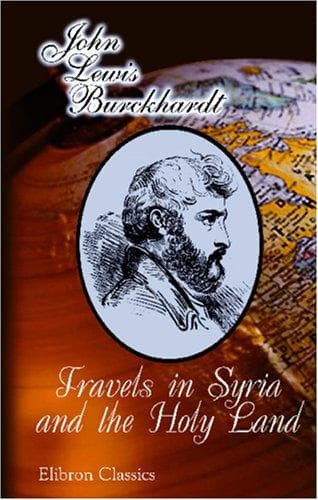
Travels in Syria and the Holy LandBurckhardt, John Lewis
History
Travels in Syria and the Holy Land
Burckhardt, John Lewis
Palestine -- Description and travel; Syria -- Description and travel
Since the Journey of Lord Belmore, Mr. Waddington and Mr. Hanbury,
taking advantage of an expedition sent into AEthiopia by the Viceroy of
Egypt, have prolonged the examination of the Nile four hundred miles
beyond the extreme point reached by Burckhardt; and some French
gentlemen have continued to follow the army as far as Sennaar. The
presence of a Turkish army in that country will probably furnish greater
facilities for exploring the Bahr el Abiad, or western branch of the
Nile, than have ever before been presented to travellers; there is
reason to hope, that the opportunity will not be neglected, and thus a
survey of this celebrated river from its sources to the Mediterranean,
may, perhaps, at length be made, if not for the first time, for the
first time at least since the extinction of Egyptian science.
The expedition of the Pasha of Egypt has already produced some important
additions to African geography. By permission of Mr. Waddington, the
Editor has corrected, from that gentleman's delineation, the parts of
the Nile above Mahass, for the second [p.xix] edition of Burckhardt's
Nubia, and from the information transmitted to England by Mr. Salt, he
has been enabled to insert in the same map, the position of the ruins of
an ancient city situated about 20 miles to the north-eastward of Shendy.
These ruins had already been partially seen by Bruce and Burckhardt,
[Burckhardt passed through the vestiges of what seems to have been a
dependency of this city on the Nile, at seven hours to the north of
Shendy, and two hours to the south of Djebail; the latter name, which is
applied by Burckhardt to a large village on a range of hills, is
evidently the same as the Mount Gibbainy, where Bruce observed the same
ruins, which have now been more completely explored by M. Cailliaud. See
Travels in Nubia, p.275. Bruce's Travels, Vol. iv. p.538, 4to.] and
there can be little doubt that Bruce was right in supposing them to be
the remains of Meroe, the capital of the great peninsula of the same
name, of which the general geography appears to have been known with
considerable accuracy to men of science in the Augustan age, although it
had not been visited by any of the writers whose works have reached us.
For, assuming [To illustrate the following observations, as well as some
of the preceding, a small drawing of the course of the Nile is inserted
in the margin of the map of Syria which accompanies the present volume.]
these ruins to mark the site of the city Meroe, and that the latitude
and longitude of Shendy have been accurately determined by Bruce, whose
instruments were good, and whose competency to the task of observation
is undoubted, it will be found that Ptolemy is very nearly right in
ascribing the latitude of 16.26 to the city Meroe.[Ptolem. l.4,c.8.]
Pliny [Plin. Hist. Nat. l.2,c.73.] is equally correct in stating that
the two points of the ecliptic, in which the sun is in the zenith at
Public-domain text, read in full here on John Shaqi.
Reviews
Reviews
No reviews yet
Be the first to share your thoughts on this work.
Join the Discussion
Join the discussion
Sign in to leave a comment or review.
Sign InorCreate an account