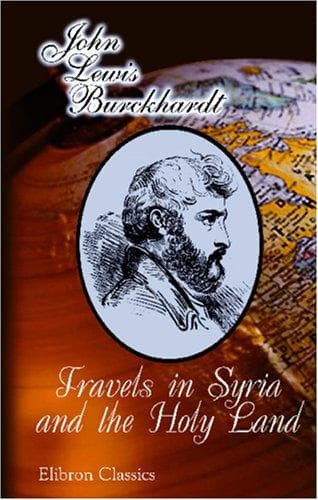
Travels in Syria and the Holy LandBurckhardt, John Lewis
History
Travels in Syria and the Holy Land
Burckhardt, John Lewis
Palestine -- Description and travel; Syria -- Description and travel
Meroe, are the 18th degree of Taurus, and the 14th degree of Leo. The
5000 stades which Strabo[Strabo, p. 113.] and Pliny [Plin. ibid.] We
learn from another passage in Pliny, (l.6,c.29,) that the persons sent by
Nero to explore the Nile, measured 884 miles, "by the river", from Syene
to Meroe.] assert to be the distance between Meroe and Syene is correct,
at a rate of between 11 and 12 [p.xx]stades to the geographical mile; if
the line be taken in direct distance, as evidently appears to have been
the intention of Strabo, by his thrice stating (upon the authority of
Eratosthenes,) that the distance from Meroe to Alexandria was 10,000
stades.[Eratosth. ap. strab. p. 62. Strabo, p. 113, 825.] The latitudes
of Ptolemy equally accord in shewing the equidistance of Syene from
Meroe and from Alexandria; the latitude of Syene being stated by him at
23-50,[Ptolem. l.4,c.6.] and that of Alexandria at 31-0. [Ptolem. ibid.]
The description of the island of Meroe as being 3000 stades long, and
1000 broad, in form like a shield, and as formed by the confluence of
the Astasobas, Astapus, and Astaboras,[Eratosth. ap. Strab. p.786.
Strab. p.821. Diodor. Sic. l.l,c.33. Heliodor. AEthiop. l.10,c.5] is
perfectly applicable to the great peninsula watered on the east by the
Tacazze, and on the west by the Bahr el Abiad, after receiving the Bahr
el Azrek. The position of the city Meroe is shewn by Artemidorus,
Ptolemy, and Pliny,[Artemid. ap. Strab. p.771. Ptolem. l.4,c.8. Plin.
Hist. Nat. l.6,c.29.] to have been, like the ruins near Shendy, near the
northern angle of the island, or the confluence of the rivers. The
island between Djebail and Shendy which Bruce calls Kurgos, answers to
that which Pliny describes as the port of Meroe; and finally, the
distance of "15 days to a good walker," which Artemidorus [Artemid.
ibid.] places between Meroe and the sea, giving a rate of about 16
English miles a-day, in direct distance, is a correct statement of the
actual distance between the ruins near Shendy and Souakin. [It is fair
to remark, that there are two authorities which tend to place the city
of Meroe 30 or 40 miles to the southward of the ruins near Shendy.
Eratosthenes states it to have been at 700 stades, and Pliny at 70 miles
above the confluence. But it is rare indeed to find a coincidence of
many ancient authorities in a question where numbers are concerned,
unless one author has borrowed from another, which is probably the case
in regard to the two just quoted.]
Public-domain text, read in full here on John Shaqi.
Reviews
Reviews
No reviews yet
Be the first to share your thoughts on this work.
Join the Discussion
Join the discussion
Sign in to leave a comment or review.
Sign InorCreate an account