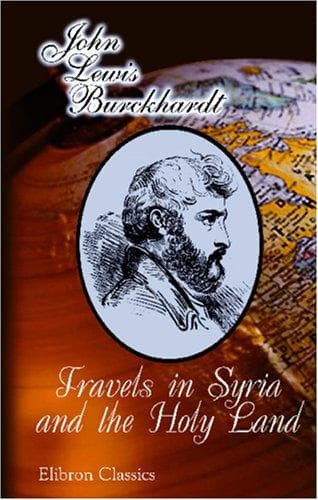
Travels in Syria and the Holy LandBurckhardt, John Lewis
History
Travels in Syria and the Holy Land
Burckhardt, John Lewis
Palestine -- Description and travel; Syria -- Description and travel
The inhabitant of the Haouran estimates his wealth by the number of
Fedhans,[The word Fedhan is applied both to the yoke of oxen and to the
quantity of land cultivated by them, which varies according to
circumstances. In some parts of Syria, chiefly about Homs, the Fedhan el
Roumy, or Greek Fedhan, is used, which means two pair of oxen.] or pairs
of cows or oxen which he employs in the cultivation of his fields. If it
is asked, whether such a one has piastres (Illou gheroush [ARABIC]), a
common mode of speaking, the answer is, "A great deal; he drives six
pair of oxen," (Kethiar bimashi sette fedhadhin [Arabic]); there are but
few, however, who have six pair of oxen; a man with two or three is
esteemed wealthy: and such a one has probably two camels, perhaps a
mare, or at least a Gedish (a gelding), or a couple of asses: and forty
or fifty sheep or goats.
The fertility of the soil in the Haouran depends entirely upon the water
applied to it. In districts where there is plenty of water for
irrigation, the peasants sow winter and summer seeds; but where they
have to depend entirely upon the rainy season
[p.296]for a supply, nothing can be cultivated in summer. The harvest in
the latter districts, therefore, is in proportion to the abundance of
the winter rains. The first harvest is that of horse-beans [Arabic] at
the end of April: of these there are vast tracts sown, the produce of
which serve as food for the cows and sheep. Camels are fed with the
flour made from these beans, mixed with barley meal, and made into a
paste. Next comes the barley harvest, and towards the end of May, the
wheat: in the interval between the two last, the peasants eat barley
bread. In abundant years, wheat sells at fifty piastres the
Gharara,[Three Rotola and a half make a Moud, and eighty Moud a Gharara.
A Rotola is equal to about five and a halfpounds English.] or about two
pounds ten shillings for fifteen cwt. English. In 1811, the Gharara rose
as high as to one hundred and ninety piastres. The wheat of the Haouran
is considered equal, if not superior to any other in Syria. Barley is
generally not more than half the price of wheat. When I was in the
Haouran, the price of an ox or cow was about seventy piastres, that of a
camel about one hundred and fifty piastres.
The lands which are not capable of artificial irrigation are generally
suffered to lie fallow one year; a part of them is sometimes sown in
spring with sesamum, cucumbers, melons, and pulse. But a large part of
the fruit and vegetables consumed in the Haouran is brought from
Damascus, or from the Arabs Menadhere, who cultivate gardens on the
banks of the Sheriat el Mandhour.
Public-domain text, read in full here on John Shaqi.
Reviews
Reviews
No reviews yet
Be the first to share your thoughts on this work.
Elsewhere in the archive
Join the Discussion
Join the discussion
Sign in to leave a comment or review.
Sign InorCreate an account