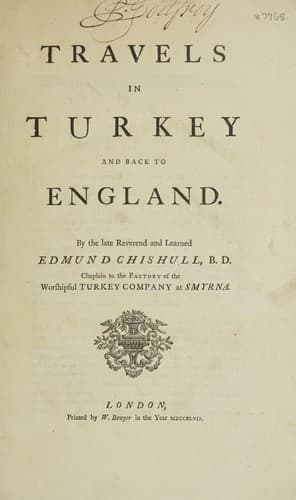
Travels in Turkey and back to EnglandChishull, Edmund
History
Travels in Turkey and back to England
Chishull, Edmund
Turkey -- Description and travel -- Early works to 1800
The once glorious and renowned _Ephesus_ was seated in a fruitful vale,
encompassed almost round with mountains[43], at a small distance from the
_Caýster_, and about five miles eastward from cape _Trogilium_; where, at
the common charge of all _Ionia_, the _Panionia_, or _common councils of
Ionia_, were formerly celebrated. This vale rises advantagously in the
middle with two or three little hills[44], on which the several parts of
the antient city lay extended. The same spot of ground is still covered
with the rich remains of its former glory. Such are the massy walls, the
portals, the arches, the aqueducts, the marble chests, together with the
dejected cornishes, shafts, and capitals of many lofty pillars. But the
face of the whole yeilds a melancholy and disagreable prospect, being
overrun with an incredible quantity of rank and luxuriant weeds, which
serve only to corrupt the air, and to conceal the curiosities of the
place. This we found to be a disadvantagous circumstance, and such as
doubled the labour of this day in compassing the circuit of the city,
and tracing the uncertain footsteps of so many valuable antiquities. But
because these cannot so intelligibly be represented in the order, in
which we viewed them, we shall methodically consider _Ephesus_, as lying
in three distinct ruins of a Turkish, Christian, and Heathen city.
The freshest ruins of this place appear to be Turkish, and such as
witness, that it has been in considerable repute even under its last
barbarous conqueror; who also has changed the name of _Ephesus_ into that
of _Aiasalúck_. Here are to be seen the remains of five or six _mosques_,
besides one which is still used for Mahometan service. In several
places there occur the walls of ruined bagnios, tho they are incredibly
increased by the fabulous Turks, and reported to have been here to the
number of three hundred and sixty six. But that, which most plainly
evidences the late riches of the place, are the many beautiful monuments,
which we viewed among their burying places, most of them inscribed with
fair Turkish characters. Tis observable, that these are cut rising
from the plane of the stone, and not indented within the surface; which
is the constant fashion of the Turks in all their public monuments, in
opposition to the custom of other times and nations. It is not certain,
whether the new castle, which stands to the northward of the old citadel,
be of Grecian or Turkish fabric; however it is still kept in repair by
the Turks, and filled within the circuit of the walls with fifty or sixty
small cottages, which with two or three scattering tenements are the only
habitations of the present _Ephesus_.
Public-domain text, read in full here on John Shaqi.
Reviews
Reviews
No reviews yet
Be the first to share your thoughts on this work.
Join the Discussion
Join the discussion
Sign in to leave a comment or review.
Sign InorCreate an account