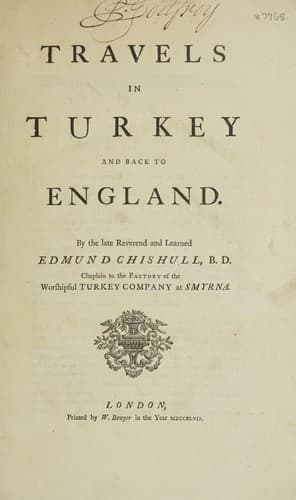
Travels in Turkey and back to EnglandChishull, Edmund
History
Travels in Turkey and back to England
Chishull, Edmund
Turkey -- Description and travel -- Early works to 1800
For such monuments of Christianity, as are here visited by travelers,
we are beholden to the tradition of the neighbouring Christians; who
shew the place of _St. Mark’s_ and _St. Paul’s_ church, together with
the standing walls of that dedicated to _St. John_; which last apostle,
returning from his banishment in _Patmos_ upon the death of _Domitian_,
lived, and died, and was interred at _Ephesus_[45]. The church of _St.
John_, tho still entire, is however miserably transformed, and converted
into the profane use of a Turkish _mosque_. Like all other _mosques_ of
the better fashion, it has a square and spacious yard on the north side,
with three different entrances belonging to it. Those to the east and
west are reasonably well beautified, being adorned above the portals
with curious Turkish sculptures, and materials of rich polished marble.
From this yard we enter the _mosque_ by five wooden doors, all of which
are carved to an exquisite perfection. Within appear a splendid pulpit
and _kiblé_, both consisting of wrought marble, and the latter more
particularly imbellished with painting and gilding of great art and
variety. But what are most justly admired and celebrated by all, who
have traveled hither, are the four pillars of granate marble, standing
in a right line from east to west, and supporting two cupolas, that
compose the roof. They are so far disproportioned, that the least is
almost three, and the biggest near four feet diameter; besides which
the pedestals of some are quite covered with the floor, and all besides
one, which is of the compound order, have lost their antient capitals.
All these are circumstances, which unanswerably demonstrate, that these
pillars are now transported from their first places. And in truth, when
the whole fabric is diligently compared with all other Turkish _mosques_,
and this consideration further added, that there appears no sign of
an altar to the east, or door to the west end; it will be more than
probable, that nothing but the southern wall can be the remains of a
Christian church. About a mile to the south west of this place, and in
the midst of the antient city, stands an high wall, and adjoining thereto
a stately gatehouse, in which are these words, most curiously engraven:
.... ACCENSO ....
.... RENSI ET ASIAE ...
Public-domain text, read in full here on John Shaqi.
Reviews
Reviews
No reviews yet
Be the first to share your thoughts on this work.
Join the Discussion
Join the discussion
Sign in to leave a comment or review.
Sign InorCreate an account