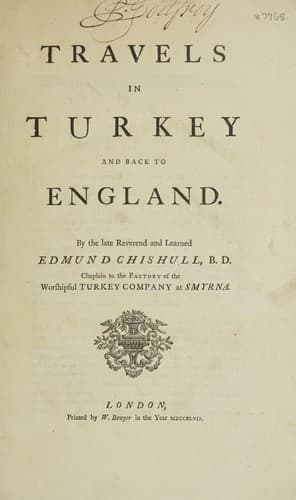
Travels in Turkey and back to EnglandChishull, Edmund
History
Travels in Turkey and back to England
Chishull, Edmund
Turkey -- Description and travel -- Early works to 1800
Together with this imperfect inscription are to be seen the defaced
figure of a man on horseback, and another of a serpent twisted round a
tree. This is by most adjudged to be a Christian ruin; and indeed if we
consider its beauty and grandeur, as it can be no very modern building,
so by reason of its misplaced carvings and inverted inscriptions it
cannot be very antient; but may conveniently be refered to those
times, in which Christianity began to flourish here. And after this
there will be room to put in another conjecture, and to guess from the
stateliness of the fabric, that it might be the place, where that famous
general council of almost two hundred bishops condemned the heresy
of _Nestorius_, in the year four hundred thirty one; tho his errors
are still living among the Indians and Chaldeans, two sects which are
numerous in the eastern parts of _Asia_[46]. Those other Christian
monuments, which are commonly shewn at _Ephesus_, are merely fabulous;
and serve only to cheat and abuse the curiosity of many travelers, who
undergo no little pains and difficulty in coming hither. Such are the
_cave of the seven sleepers_; the _font_, in which _St. John_ is said to
have baptized so many primitive Christians; and a square watch tower,
which ordinarily goes by the name of _St. Paul’s prison_. This last
stands upon a small hill, about a mile nearer the sea, than was the
_temple of Diana_; and is indeed worth visiting by those, who have not
so much superstition or credulity; for its situation gives a commanding
prospect over the stream of the _Caýster_, which here seems to rival the
_Maeander_, and plays with many wanton windings in the adjoining plain.
The chief heathen antiquities, that are to be seen at _Ephesus_, are
the remainder of the _old citadel_, and the foundation of the _temple
of Diana_. The former of these is an intire gate, with two broken walls
adjoining on each side, which being situated on a convenient ascent,
towards the north east of the ancient city, most probably was a sort
or citadel, that defended it on that quarter. This gatehouse has the
marks of considerable antiquity, tho it has been rebuilt from other more
antient ruins; as is evident from some misplaced stones, and broken
reversed inscriptions, that occur in the work. Among these are viewed
with great satisfaction three flat marble stones, curiously cut in _basso
relievo_; which tho of different design, and unequal breadth, are placed
in a line to adorn the arch of the gate.
The first of these marbles (reckoning from the left hand as we front
the gate) has been somewhat injured by time; but from the portraiture
of grapes and baskets, and four or five figures in gay and youthful
postures, it may be presumed to represent a _Bacchanal_.
Public-domain text, read in full here on John Shaqi.
Reviews
Reviews
No reviews yet
Be the first to share your thoughts on this work.
Join the Discussion
Join the discussion
Sign in to leave a comment or review.
Sign InorCreate an account