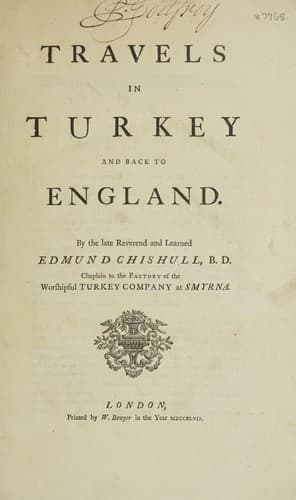
Travels in Turkey and back to EnglandChishull, Edmund
History
Travels in Turkey and back to England
Chishull, Edmund
Turkey -- Description and travel -- Early works to 1800
This day I attended the funeral of Signior _Demetrasco_, chief _dragoman_
to the English ambassador, who tho by faith a Latin, yet by birth was
of the Greek nation. And accordingly in the way of burying proper to
this latter, I observed the manner of carrying the corps of the deceased
barefaced, clothed in his late usual habit, and supported by four of his
nearest relations; who were followed by women slaves, hired to make a
hideous pomp, by tearing their hair, extorting forced and counterfeit
tears, and repeating in a continual loud and frightful lamentation, ὦ
ἀφέντη μου; that is, _O my master!_
April xv.
I paid a visit to Signior _Rombarts_, a gentile and ingenious merchant
of the Dutch nation, at his house in _Curuchesmée_, a village on the
Thracian _Bosphorus_. Here I observed a _sophá_ room remarkably adorned
after the richest Turkish fashion, the roof formed into a cupola, and the
gilding and painting of the whole so splendidly curious, that it amounted
at first to the sum of four thousand _hungárs_, or two thousand pounds
sterling.
April xvii.
I took the opportunity of passing over the chanel to _Constantinople_, in
company of Signior _Wright_, the Dutch minister of this place, with whom
I visited the _mint_; the _Grand Signior’s_ lions; and the _mosques_ of
_Sultan Solymán_, _Sultan Bajazet_, _Sultan Achmét_, and the _Validée_.
That of _Bajazet_ and the _Validée_ are adorned only with two _minarées_,
that of _Solymán_ with four, and that of _Achmét_ with six. They all much
resemble one another, both in the inward and outward figure. They first
consist of a spatious court, enriched all round with fair and regular
cloisters formed by pillars, some of whose shafts are carved with white
marble, some with serpentine stone, and some with porphyry; but all
the capitals are of the modern Turkish figure. Next is the body of the
_mosque_, covered outwardly with domes, and supported inwardly with four
massy pillars, from the tops of which rises a regular cupola, forming
the roof of the whole _mosque_. Whoever exactly compares the beauty and
grandeur of these several _mosques_, will find that of _Solymán_ more
regular, and artificial in the outward frame; that of _Achmét_ more
magnificent in the whole, and on the outside more beautiful in the work
of the pillars; that of the _Validée_, tho less in bulk and extent than
the other two, yet more curious in the inward ornaments and workmanship
than either; and that of _Bajazet_, which is the oldest, inferior to
the rest both in bulk and beauty, except that some cast pillars, which
form the cloisters of the court, consist of a more polite, shining, and
pretious stone.
Public-domain text, read in full here on John Shaqi.
Reviews
Reviews
No reviews yet
Be the first to share your thoughts on this work.
Join the Discussion
Join the discussion
Sign in to leave a comment or review.
Sign InorCreate an account