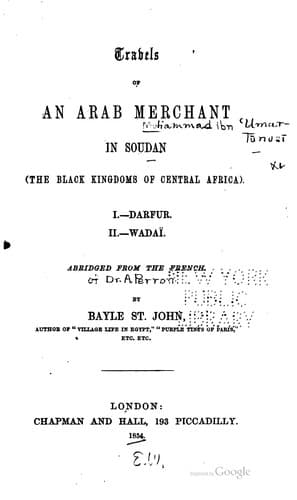
Travels of an Arab merchant in Soudan (the Black Kingdoms of Central Africa) — John Shaqi
Travels of an Arab merchant in Soudan (the Black Kingdoms of Central Africa)Tūnisī, Muḥammad ibn ʻUmar
History
Travels of an Arab merchant in Soudan (the Black Kingdoms of Central Africa)
Tūnisī, Muḥammad ibn ʻUmar
Darfur (Sudan) -- Description and travel; Wadai (Sultanate) -- Description and travel
“But,” said my father, “art thou now thinking of returning
to our country, and of refreshing the eyes of thy family?”
“I will return, if it please God.”
“And when?”
“I am now going to Cairo to sell my female slaves. Then I shall
return to Sennaar, to take my children and whatever I possess; and
afterwards I shall set out for Egypt. Go thou upon the pilgrimage,
and we shall meet again at Cairo. Whoever arrives first shall wait
for the other.”
So they said, “Adieu!” and the two caravans separated in the
desert. My father and his uncle went upon their pilgrimage, and
my grandfather continued his journey to Cairo, where he sold his
slaves, and, having made his purchases, returned to his adopted
country. Meanwhile the pilgrims arrived at the holy city, and
performed their pious duties; but the elder of them died, and was
buried near the gate of Mala. So Omar returned alone to Cairo, and,
whilst waiting for his father, attended on the scientific lectures
in the mosque of El-Azhar. But he waited in vain; his father came
not; and, in his impatience, he started with a caravan which was
returning direct to Sennaar.
Having arrived in that country, he found his father comfortably
settled, surrounded by his wives and children, and having no
thoughts of departure. He asked him why he had broken his promise,
and had laughed at him. My grandfather gave an evasive answer, to
the effect that his debtors would not pay him, and persuaded Omar
to wait six months longer. A caravan then preparing to depart for
Egypt, Omar said,—
“My father! wilt thou come along with us, or shall I go away
alone?”
“Neither the one nor the other. It is not convenient for me
to go to Tunis, where I owe money. Besides, I have learned that
thy mother has married again. As for thy departure, put it off;
thou must be provided for that purpose with slaves, camels, gold,
and merchandise.”
My father refused to remain any longer, saying: “I wish to become
learned, and all the time I spend here is pure loss.”
Upon this they quarrelled, and my father went away in anger with the
caravan, not possessing a single para. But three days afterwards,
my grandfather came riding after him, and gave him three camels,
four young slave-girls, two black slaves, provisions and water-skins,
and a camel-load of gum. My father received the whole, and continued
his journey with the caravan; but some time afterwards they strayed
from the track and lost their way. Thirst made itself felt, the
passage of the desert was prolonged, and the slave-girls and the
camels which had been given to my father died, so that he became as
poor as before. Well has a poet said, that when Fortune is willing
to follow you can lead her with a hair, but when she wishes to turn
away, she can break chains of iron.
Public-domain text, read in full here on John Shaqi.
Reviews
Reviews
No reviews yet
Be the first to share your thoughts on this work.
Join the Discussion
Join the discussion
Sign in to leave a comment or review.
Sign InorCreate an account