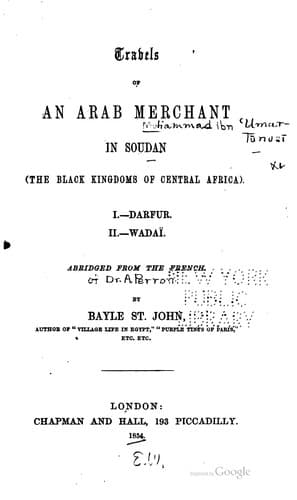
Travels of an Arab merchant in Soudan (the Black Kingdoms of Central Africa)Tūnisī, Muḥammad ibn ʻUmar
History
Travels of an Arab merchant in Soudan (the Black Kingdoms of Central Africa)
Tūnisī, Muḥammad ibn ʻUmar
Darfur (Sudan) -- Description and travel; Wadai (Sultanate) -- Description and travel
Among these presents was a young girl of charming aspect, and of
great price, named Halymah. Fascinated by her beauty, my father
took her as his concubine, and had by her a son and a daughter,
as beautiful as their mother. The king, moreover, assigned to him
a fixed income; so that he utterly forgot his family, which had
remained in Tunis, and the three young children he had left under
the charge of their mother.
Now, of these children, my late uncle, named Mohammed, was about
that time nine years old; the second—may God save his soul!—was
called Omar, and was six years old—this was my father; the third,
Mohammed Tahir, was three years old. They were all placed under
the guardianship of their maternal uncle, Seyd Ahmed, son of the
learned Sulieman-el-Azhary. This was a man of high character and
immense learning, author of many esteemed books. On account of his
great knowledge of theology, the functions of Kady of Tunis had
been offered to him, but he had refused. He occupied himself in
giving lessons, at first in a college, but afterwards—on account
of ill-health—in his own house, where all the great people came
to listen to his lectures.
My father remained with him until he came to man’s estate, and
profited much by his instruction. But, then, the desire moved him to
perform the pilgrimage, and he laid the subject before his uncle,
who was at once stirred by the same laudable wish, and gave up his
lectures and prepared for departure. They embarked and proceeded
to Alexandria, and thence to Cairo; and afterwards started for
Cosseir, some months before the season of the pilgrimage. As they
were crossing the desert, they beheld approaching another caravan,
composed of Magrebyns, coming from Sennaar. When they drew nigh
they began to shout out questions one to the other; and those coming
from Sennaar cried,—
“Ho! ho! is there any one amongst you from Tunis?”
“Yes,” replied my father, “we are from Tunis.”
“Do you know one Ahmed, son of Suleiman?”
“Yes,” said my father; “and who art thou?”
“I am his brother-in-law. I left Tunis a long time ago—my
children and all my family—and I know not whether they are dead
or alive.”
Now the uncle of my father was under a kind of palanquin, covered
with cloth; but had overheard this conversation.
“Omar,” said he, “go and salute thy father. It is he; and
tell him I am here.”
So Omar jumped off his camel, and, running to his father, kissed
his hand, and told him that the brother of his wife was under
the palanquin.
My grandfather hastened and saluted the son of Suleiman, and when
they were somewhat tranquillised, Omar said to his father,—
“How comes it that thou hast left us so long, without any resource,
young as we are? If God had not awakened the bounty of my uncle,
we should have been lost.”
My grandfather explained that he had been the victim of destiny,
and quoted the words of a poet in support of his statement.
Public-domain text, read in full here on John Shaqi.
Reviews
Reviews
No reviews yet
Be the first to share your thoughts on this work.
Join the Discussion
Join the discussion
Sign in to leave a comment or review.
Sign InorCreate an account