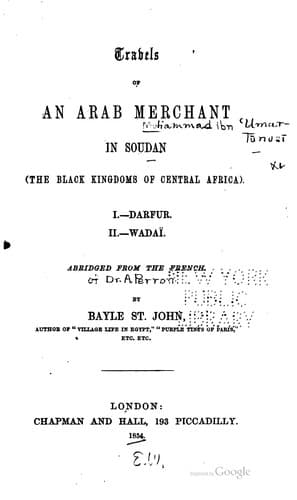
Travels of an Arab merchant in Soudan (the Black Kingdoms of Central Africa)Tūnisī, Muḥammad ibn ʻUmar
History
Travels of an Arab merchant in Soudan (the Black Kingdoms of Central Africa)
Tūnisī, Muḥammad ibn ʻUmar
Darfur (Sudan) -- Description and travel; Wadai (Sultanate) -- Description and travel
The Wadaïans, properly so called, or primitive inhabitants of
Wadaï, occupy more especially the central portion of the kingdom. It
is amongst them that are chosen the viziers and the especial troops
of the Sultan. The country they inhabit is hilly, and there is found
Mount Absenoun. The people of this mountain consider themselves as
the original source of the Wadaïans, all of whom, they say, are
issued from them. Some leagues north of Senoun is Mount Melangan. The
Senawans are of a dark black colour, of elevated stature, and
strongly built, reminding one of the redoubtable Amalekites. The
Melangans are less dark, and have something of a bronze tint.
The Kashmereh are established at four days’ distance from Warah
to the south, in the Botagha, a charming, well-watered valley,
where they sow a great quantity of vegetables and plants which serve
as condiments, such as pepper, coriander, garlic, and onions. The
tribe has its dwellings on the northern side of the valley, and is
spread over a surface of four days in length and of only four hours
in width. The villages are small, and extend along the crest of the
hill like the pearls of the necklace of a houri. Sultan Saboun had
given to my father the administration and the revenue of five of
these Kashmereh villages, which certainly were more profitable than
fifty Forian ones. All their stations are well peopled and full of
life. From the smallest of them, if the trumpet of war were sounded,
at least five hundred vigorous men would issue. I am persuaded that
this tribe alone would furnish an imposing army. They are, moreover,
submissive, and more easy to lead than the other Wadaïans. They live
in plenty, and their families have numerous children. Their nature
is simple and docile, without meanness. They are of middle stature,
and of a complexion between white and black. Their language differs
from that of the other Wadaïans.
The Koukah are established to the south-east of Wadaï, and form
three divisions. They are esteemed by the Wadaïans on account of
the slaves which are derived from them to serve as concubines. There
is especially one division which supplies magnificent women, even
preferable to the most attractive Abyssinians. The young slave-girls
which are brought from thence are ravishingly beautiful, and endowed
with grace that stirs all the emotions of the heart. Their charms
trouble and torment the soul, turn the heads of the most devout
ascetics, and lure them to pleasure. The Koukah tribe is numerous,
and their country is well watered. According to the Wadaïans,
all the inhabitants of the Dar-Seleih may be bought and sold,
except the five original families.
Public-domain text, read in full here on John Shaqi.
Reviews
Reviews
No reviews yet
Be the first to share your thoughts on this work.
Elsewhere in the archive
Join the Discussion
Join the discussion
Sign in to leave a comment or review.
Sign InorCreate an account