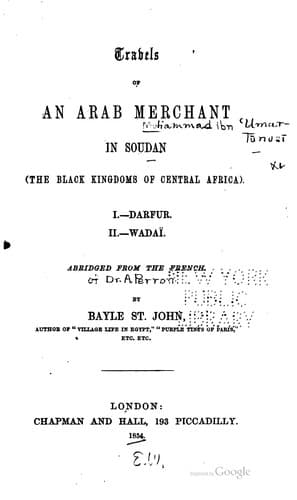
Travels of an Arab merchant in Soudan (the Black Kingdoms of Central Africa)Tūnisī, Muḥammad ibn ʻUmar
History
Travels of an Arab merchant in Soudan (the Black Kingdoms of Central Africa)
Tūnisī, Muḥammad ibn ʻUmar
Darfur (Sudan) -- Description and travel; Wadai (Sultanate) -- Description and travel
All the peoples and tribes of Wadaï are governed by kings, to whom
the title of Sultan is never given. Indeed, the Wadaïans will
not admit that there exists in the whole world any other Sultan
than theirs. All the other Sultans, according to them, are only
Meliks. No one must say to a Wadaïan that there is a Sultan in his
country, under pain of being taken severely to task; and if any one
of the country were to use that expression he would most probably be
insulted. Nevertheless, in conversation, the people never say Sultan,
but use the word Melik, in speaking of their sovereign. The fact is,
their language does not contain the word Sultan. It is a poor, hard,
and rough dialect, in which the letter _k_ constantly occurs. The
commonest syllable is _ak_, God is Kalak, and the same word means a
young child. Karak means a pious man, and also a pumpkin. One day
I heard a kabartou, or crier and public executioner, blowing his
trumpet, and singing his warlike song. I asked what he was saying,
and was told that his words meant “hungry bird, come and eat;”
that is to say, massacre your enemies, and may the hungry birds feed
to satiety upon their flesh. I did not, however, remain long enough
in the country to learn the language, and, indeed, did not think it
necessary to do so, many of them speaking Arabic. I only knew what
was necessary for ordinary life,—the names of water, of bread, of
meat, household utensils, clothes, &c.; but as for a long time I have
not had occasion to use these words, I forget them. Moreover, all the
tribes of Wadaï have a particular language, each totally different
from the other—as different as their physical characteristics. The
Wadaïans, in fact, have a large head, a long face, strong joints,
and elevated stature; generally, the men are handsomer than the
women. The Kashmereh have an oval face, are of middle height,
with joints not prominent. The Birguid have small heads, slender
bodies, short stature, and are in general very black. The Koukah
are mulatto-coloured, slight, and active; the women are handsomer
than the men. Each of these people, therefore, has a physiognomy
so distinct that it is recognised at once. It is not long since the
Wadaïans were almost savages. They have only begun to be civilised
for about half a century. Before that period they were confined or
shut up within their frontiers, after the manner of the Chinese,
allowing no one to go out, not even strangers who came to visit
them. They feared that some foreign nation might be excited to
attack and conquer their country. If a stranger arrived he was
well treated and fed, but could never hope to depart. This custom
was persisted in until the time of Sultan Saleh, who was a man of
intelligence and good sense, fearing God and loving goodness. Under
his reign some merchants came to trade at Wadaï, and were allowed
to depart again. From that time forth caravans began to arrive, and
the movement continued until Saboun came to the throne. Then the
Public-domain text, read in full here on John Shaqi.
Reviews
Reviews
No reviews yet
Be the first to share your thoughts on this work.
Elsewhere in the archive
Join the Discussion
Join the discussion
Sign in to leave a comment or review.
Sign InorCreate an account