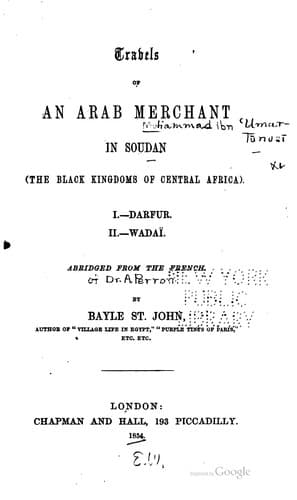
Travels of an Arab merchant in Soudan (the Black Kingdoms of Central Africa)Tūnisī, Muḥammad ibn ʻUmar
History
Travels of an Arab merchant in Soudan (the Black Kingdoms of Central Africa)
Tūnisī, Muḥammad ibn ʻUmar
Darfur (Sudan) -- Description and travel; Wadai (Sultanate) -- Description and travel
prosperity of the country increased, and the reign of that prince
was a series of blessings. He gave presents to the merchants, to
incite them to return to his country. The news of his generosity
spread far and wide, and traders began to fall upon Dar-Saleh like
showers of fertilising rain. Ulemas and poets came from distant
countries to visit the prince. His reign was beautiful as the spring,
generous as the beneficent dew. The only reproach that could be made
against him was, that by his hospitable treatment strangers were so
fascinated that they forgot all their other friends, and even their
families. Saboun, from his youth upwards, was a rigid observer of
all the principles consecrated by religion. No one could reproach
him with neglect of any duties. When he became Sultan he caused
the law to be respected, and applied it severely to all criminals,
however high placed. In no country have I seen, as in Wadaï, the
punishment prescribed by the law inflicted for adultery. I have
seen Saboun condemn a woman for this crime. She was buried upright,
up to her breast, in the earth, and then stoned to death.[37] As
for the use of wine, I have seen this crime as severely punished
in other countries as in Wadaï.
The love of Saboun for science caused a great many learned men to
collect around him. The most distinguished was Ahmed-el-Fasi. After
him came the Imâm Nour, the great Kadi, who was an Arab belonging
to one of the neighbouring tribes. The Fakih Wali of Bagirmeh was
a distinguished poet, and composed several copies of verses in
praise of the Sultan. Many other learned and able men were to be
found among the courtiers of Saboun.
I have already mentioned the courage which distinguishes the
people of Wadaï, who surpass in valour most of the neighbouring
tribes. They are far more intrepid than the people of Bornou,
which is a country vaster and richer than theirs. I have often been
told that the Fullans, or Fellatahs, have conquered the Bornouese
nearly every time they have fought with them. When my father went
from Bagirmeh to Bornou, the Fellatahs had just gained a great
victory over that country, and its Sultan had fled away to the
province of Kanoum. Here the able vizier, Emin, received him, and,
having collected a large army, succeeded in replacing him on the
imperial throne.
Public-domain text, read in full here on John Shaqi.
Reviews
Reviews
No reviews yet
Be the first to share your thoughts on this work.
Elsewhere in the archive
Join the Discussion
Join the discussion
Sign in to leave a comment or review.
Sign InorCreate an account