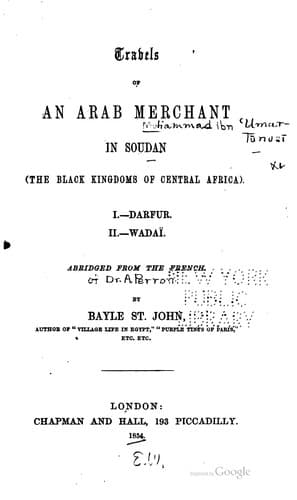
Travels of an Arab merchant in Soudan (the Black Kingdoms of Central Africa)Tūnisī, Muḥammad ibn ʻUmar
History
Travels of an Arab merchant in Soudan (the Black Kingdoms of Central Africa)
Tūnisī, Muḥammad ibn ʻUmar
Darfur (Sudan) -- Description and travel; Wadai (Sultanate) -- Description and travel
On one occasion the Sultan of Bornou, about the time of the wars
of Zaky, sent an army, under the command of one of his viziers,
to meet the Fullans. There were with them some Magrebyn and Bedawin
Arabs. The Bornouese, during their march, entered a vast sandy plain,
which stretched farther than the eye could reach, and perceived in
the distance a great black mass, covering the whole horizon. They
imagined that this mass was the army of the Fellatahs. Fear seized
upon them, and chilled their souls. The head of the column halted in
consternation, and soon the whole warlike array came to a full stop,
and then began to retrograde, the soldiers crying one to the other
that it was impossible to resist so great a multitude. A Magrebyn
went to the vizier in command, and said,—
“What! do your troops disband at sight of that black mass,
without knowing what it really is?”
“Who,” said the Vizier, “will go and reconnoitre?”
“I will.”
So the Magrebyn rode out alone across the plain, and soon discovered
that the supposed Fellatah army was nothing but an immense herd of
ostriches that were flapping their wings on the horizon, and thus
figured an army marching, with its banners spread. The scout wheeled
round, and returned shouting, “Come back, Bornou; come back! They
are only ostriches!” But the army, instead of listening, continued
its flight more rapidly, and arrived in complete rout at the Birny of
Kanoum, where was then the Sultan. It was found necessary, therefore,
to put all the chiefs to death, and to threaten whoever again
fled before the enemy should meet with the same punishment. Thus
incited, the army marched out under Emin, defeated the Fullans,
made a hideous massacre of them, and drove them out of the country.
I explain the conduct of the Bornouese by their long habit of easy
and peaceful life. Wherever habits of repose and inertness have
prevailed in a state, the citizens learn to fear the fatigues
and dangers of war. They have passed their time amidst physical
enjoyment, rich dishes, elegant clothing, valuable horses, beautiful
women, and the desire of the constant enjoyment of luxury has become
imperative. If unforeseen circumstances call upon men to abandon
these delights, they naturally resist and refuse to risk their
lives, and abandon their comforts, forgetting that by this conduct
the ruin of the most flourishing state is brought about, and that
the fear of losing some enjoyment often leads to the loss of all.[38]
Public-domain text, read in full here on John Shaqi.
Reviews
Reviews
No reviews yet
Be the first to share your thoughts on this work.
Elsewhere in the archive
Join the Discussion
Join the discussion
Sign in to leave a comment or review.
Sign InorCreate an account