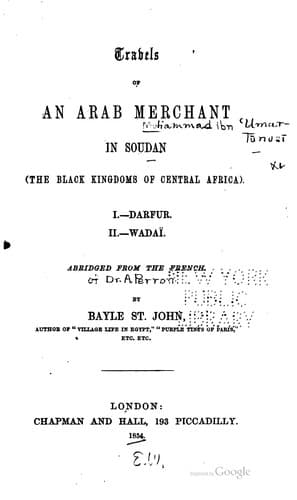
Travels of an Arab merchant in Soudan (the Black Kingdoms of Central Africa)Tūnisī, Muḥammad ibn ʻUmar
History
Travels of an Arab merchant in Soudan (the Black Kingdoms of Central Africa)
Tūnisī, Muḥammad ibn ʻUmar
Darfur (Sudan) -- Description and travel; Wadai (Sultanate) -- Description and travel
I have already said that the customs of Wadaï and those of
Darfur are similar in some respects. The houses in the latter are
more elegant, but those in the former are more solid. Warah is
a large city, surrounded by a natural rampart of mountains. The
dwelling of the Sultan is entirely of masonry, but is surrounded
by huts inhabited by slaves. To the west, outside of the wall,
is a mosque and a great square, called the Fasher, which word, in
Wadaï, is restricted entirely to this place; whilst, in Darfur,
it is applied to the whole town in which the Sultan resides. Two
lines of acacia-trees adorn the Fasher of Warah. In the first
line is a tree especially set apart for the use of the Sultan,
who sits under it every Friday on coming out of the mosque, for
the ceremony of salutation, in order to review his troops and to
receive the complaints of his people. A little to the west of the
first range of trees is another, under which the Kadis, the Ulemas,
and the Shereefs sit. There is another range of trees, a good deal
farther off, which serves as the permanent tribunal of the Kamkolak.
The great gate of the palace, which opens on the Fasher, may be used
by every one, great or small, rich or poor. Outside are numerous
huts, principally built against the wall, and inhabited by the Osban
who may be on guard. These Osban are really Turguenaks, although
the latter name is more especially applied to the superior officers
of the corps, who are four in number, each commanding a thousand
men. The Osban form the body-guard of the prince, and are also his
executioners and the instruments of his anger. On this account
they wear a uniform of imposing and menacing aspect. They wear
short tunics, carry heavy clubs, and have iron head-pieces. Every
evening a body of one thousand comes to guard the palace, five
hundred remaining without, and five hundred acting as a garrison
within. They march up in four divisions, making a frightful noise
with their tambourines or drums, which are formed of hollowed trunks
of trees, with skins stretched over each end. They do not wait to
be relieved in the morning, but march away without being replaced,
for there is no guard during the day.
The tribunal where the Sultan dispenses justice is a little square
building, built against the wall-enclosure within the first gate. The
second gate is guarded by a number of pages, who have passed the age
of puberty, and who remain within. With them also are the grooms. The
third gate is called the gate of iron, and is, indeed, covered with
iron plates.[39] Beyond this, to the right, is the Kasr; where the
Sultan sits in the afternoon during Ramad’han to listen to the
reading of the Koran. In the interval which separates the third
and fourth walls live the eunuchs and the young pages who have not
yet arrived at the age of puberty. These alone, with the Sultan,
are allowed to pass the fourth gate, which leads to the harem.
Public-domain text, read in full here on John Shaqi.
Reviews
Reviews
No reviews yet
Be the first to share your thoughts on this work.
Elsewhere in the archive
Join the Discussion
Join the discussion
Sign in to leave a comment or review.
Sign InorCreate an account