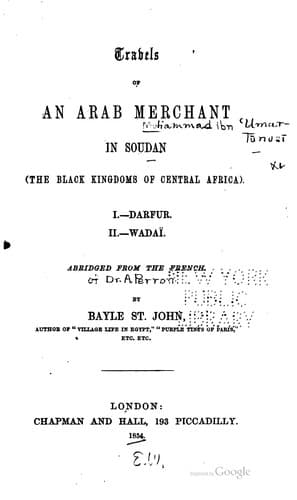
Travels of an Arab merchant in Soudan (the Black Kingdoms of Central Africa)Tūnisī, Muḥammad ibn ʻUmar
History
Travels of an Arab merchant in Soudan (the Black Kingdoms of Central Africa)
Tūnisī, Muḥammad ibn ʻUmar
Darfur (Sudan) -- Description and travel; Wadai (Sultanate) -- Description and travel
The walls and buildings of which the palace is composed are not
much higher than a man, excepting the private apartment of the
Sultan, which has a story above the ground-floor, with three windows
overlooking the whole city. The windows are merely square holes, with
two sticks placed crosswise. The dwelling-places of the eunuchs,
the pages, and the Osban, spread throughout the palace, exactly
resemble in form the Forian huts, and, like them, are constructed of
millet-stalks; but the houses of Warah have nearly all enclosures
built of earth mixed with stones. The earth used is greasy, and,
when submitted to the action of the rain, becomes covered with a
white crust as hard as iron.
Within the third gate of the palace, opposite the apartment of
Ramad’han, is a kind of large shed, where every day the Sultan
passes some time despatching business. He is separated from those
who come to him by a partition of mats, made of a kind of grass
woven with wonderful delicacy. This enclosure allows the Sultan
not only to hear what is said, but to see those who are present
without being visible to them.
The town of Warah, which is divided into two divisions, the
Tourtalou, or left division, and Toulalou, or right division, is less
populated than Tendelty. The latter place, however, is chiefly filled
with merchants and strangers, who come and go. Neither city has a
large population. The Forians are fond of pageantry and show. Each
king surrounds himself with a number of secondary kings, who form
his court, and endeavour to imitate his manners. In this way the
principal people, instead of, as in other countries, collecting in
the capital, are dispersed throughout the various districts, and
Warah may be said to be inhabited chiefly by the court of the Sultan.
The topographical position of Warah differs essentially from that
of Tendelty. The latter capital is established on a vast Gauz, or
sandy country, where every one constructs a dwelling of the best
aspect he may. Many of the habitations of the viziers approach in
appearance that of the Sultan; but at Warah, which is hemmed close
in by hills, the palace takes up so much space, that the great
people who live there are obliged to occupy very humble dwellings.
CHAPTER V.
States of Soudan — Women of Bagirmeh — The Jenakherah — The
Idolatrous Tribes — Their vast Numbers — A Slave-hunt — A
great River — Manners — Manufactures — Peculiar way of going
to bed — Marking Cattle — Cannibals — Origin of the Fullans
— Meaning of “Soudan” — A Tempest — Thunder-bolts —
Darfur and Wadaï.
Public-domain text, read in full here on John Shaqi.
Reviews
Reviews
No reviews yet
Be the first to share your thoughts on this work.
Elsewhere in the archive
Join the Discussion
Join the discussion
Sign in to leave a comment or review.
Sign InorCreate an account