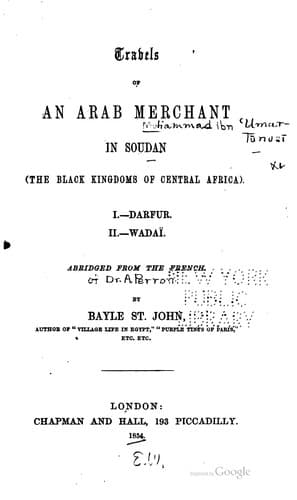
Travels of an Arab merchant in Soudan (the Black Kingdoms of Central Africa)Tūnisī, Muḥammad ibn ʻUmar
History
Travels of an Arab merchant in Soudan (the Black Kingdoms of Central Africa)
Tūnisī, Muḥammad ibn ʻUmar
Darfur (Sudan) -- Description and travel; Wadai (Sultanate) -- Description and travel
The idolatrous tribes to the south of Soudan are divided into groups
and families. They are vastly superior in number to the Muslims,
who are thrown like a chain across the desert, and it is at first
surprising that they do not overwhelm them. The explanation may be
found in the spirit of brotherhood which unites the Muslims, whilst
the Pagans are always divided one against another, each station
being inimical to its neighbour. When the enemy attacks a village,
and takes away the women and children, the people of the next village
look on without attempting to give assistance. They are attacked
next, and their neighbours regard them with equal indifference,
and so on. If these idolaters knew the strength which union gives,
none of the Muslim states of Soudan would dare to attack them.
In fact, the numerous tribes of these Majous, or Pagans, cover a
space which it takes at least three months of ordinary marching to
traverse. The Forian and Wadaïan expeditions have been often out
for six months, but have never succeeded in reaching the southern
limits. The Fakih Medeny once related to me that a Forian expedition
once pushed far into Dar-Fertyt, and resolved not to return until
they had reached the southern boundary of that country. “They
advanced,” he said, “for five months, going straight before
them. Their friends wondered at their lengthy absence, and gave
them up for lost. At the end of the five months the expedition
reached a great extent of water, on the opposite banks of which it
was difficult to distinguish an object no bigger than a man. Some
people, however, dressed in red were descried, who took to flight on
seeing the Forian troop. There being no means of crossing the water,
they were now obliged to return. I asked for information on the
distant countries of many persons who had been with the expedition,
but could obtain nothing further. A long time afterwards I met an
old man who had been on several similar excursions, and he said that
he had once penetrated to the plain of water of which I have spoken,
and that a man from Arabia, who was with him, said that the savages
of the Fertyt somewhat resembled in appearance the Hindoos. But
God knows the truth.”
The various tribes of Pagan Soudan, although very numerous,
have all artificial signs, which distinguish them one from the
other. The Bendeh file all their teeth, except the molars, into a
round shape. The Kara are distinguished by the piercing of their
lips. The Shala have the rim of their ears pierced with a series
of holes, in each of which a quill might be passed. Their women
are distinguished by the thousands of little cuts which they make
upon their stomachs—figuring rings, squares, &c., and serving as
ornaments, for they wear nothing but a very slight cloth round the
middle. Others pierce the upper lip, others draw two of their teeth,
and others make three rows of incisions upon each cheek.
Public-domain text, read in full here on John Shaqi.
Reviews
Reviews
No reviews yet
Be the first to share your thoughts on this work.
Elsewhere in the archive
Join the Discussion
Join the discussion
Sign in to leave a comment or review.
Sign InorCreate an account