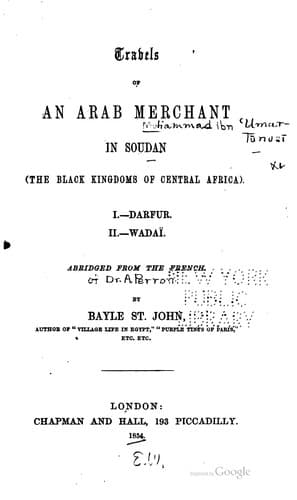
Travels of an Arab merchant in Soudan (the Black Kingdoms of Central Africa)Tūnisī, Muḥammad ibn ʻUmar
History
Travels of an Arab merchant in Soudan (the Black Kingdoms of Central Africa)
Tūnisī, Muḥammad ibn ʻUmar
Darfur (Sudan) -- Description and travel; Wadai (Sultanate) -- Description and travel
On reading this letter my father wept, and pitied the misery of
his brother and his sister. He determined at once to go and fetch
them. I was then seven years old. I had already read the whole of
the Koran once, and was reading it a second time, having come to
the end of the chapter on the family of Aaron. I had a brother four
years old. My father left us sufficient to live on for six months;
but we remained a whole year alone. My mother was obliged to sell a
great portion of our copper utensils and of her ornaments. Then my
uncle Tahir arrived at Cairo and took us under his protection. He
came with the combined object of pilgrimage and trade. He had
a boy as beautiful as the morning sun in a sky without clouds,
named Mohammed. This boy studied with me for some time; but the
plague came and he died; and was carried away to the tomb and to
the delights of the Houris. My uncle, who had intended to remain
some time in Cairo, was so saddened by the loss of his son, that he
started immediately for the holy city, leaving me money sufficient
for my expenses during four months.[3] But this time passed away,
and I was left sometimes not knowing what to eat, and nearly
naked. Meanwhile, however, I studied assiduously at the mosque
of El-Azhar. One day I learned that a caravan was arriving from
Soudan. It came from Darfur. I had learned a short time previously
that my father had departed from Sennaar for that country with his
brother. When, therefore, the caravan had entered the wakalah of
the slave-merchants, I went about amongst them inquiring if any
one knew whether my father was alive. After some time I chanced to
fall in with one of the traders, who was a grave, respectable man,
named Ahmed Bedawee. I kissed his hand and stood up before him.
“What dost thou desire, my friend?” said he to me, in a voice
full of gentleness.
“I come to ask for news of some one whom you may happen to know.”
“Who is he, and what is his name?”
“Omar of Tunis, a learned man.”
“Thou hast addressed thyself to the right person. I am his friend;
and thou, from thy face, should be his son.”
“Yes, I am he;” and I related my misfortunes.
Public-domain text, read in full here on John Shaqi.
Reviews
Reviews
No reviews yet
Be the first to share your thoughts on this work.
Join the Discussion
Join the discussion
Sign in to leave a comment or review.
Sign InorCreate an account