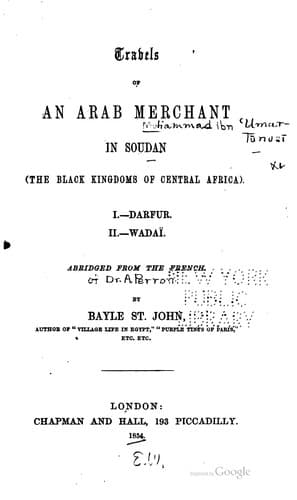
Travels of an Arab merchant in Soudan (the Black Kingdoms of Central Africa)Tūnisī, Muḥammad ibn ʻUmar
History
Travels of an Arab merchant in Soudan (the Black Kingdoms of Central Africa)
Tūnisī, Muḥammad ibn ʻUmar
Darfur (Sudan) -- Description and travel; Wadai (Sultanate) -- Description and travel
Wadaï imports almost the same articles as Darfur, although the
people are less refined in their taste, and the law interferes in
some respects. For example, the khaddour, which is the ornament of
the common women in Darfur, is restricted in Wadaï to the wives
of great personages, and no one is allowed to use Turkish saddles
except the Sultan. The articles most sought after are various kinds
of beads, natural and artificial coral, copper, calicoes, melayeh,
various kinds of perfumes, coats of mail, sabres, and yellow copper
in leaves. The Wadaïans use more silk in their ornaments than the
Forians. Asses are rarely demanded. Most of the merchandise brought
to Wadaï comes by the way of Fezzan.
In Darfur is bought a kind of bead about three fingers’ breadth
long, and generally black and white, called chor. The women string
these beads on threads taken from the leaves of the daum, or on grass
stalks. The rich interpose between a black bead and a white bead a
round bead of coral. In this way moudraahs, or armlets, worn above
the elbow, are made. Many young Forians wear these ornaments as a
sign that they love a young girl, or are beloved by her. Pledges
of affection are often interchanged in this way. To a young girl
is given generally a ring, or a cadmoul, or sash of cotton striped
with silk. In return, the lover receives a moudraah, and exhibits
it on his arm, proud of his good fortune.
When I arrived in Darfur my father had two concubines, to one of
whom he was passionately attached, being guided in his likes and
dislikes by her. One day she was engaged with some of our slaves in
arranging her collars, and I was sitting on the ground close by. A
young Arab girl of the neighbourhood came and brought a present of
a bowl of milk, which was put aside for my father, but I went and
drank it, upon which my step-mother became angry. It happened that
one of her moudraahs fell to the ground, and, being buried in the
dust, could not be found. She accordingly accused me, as soon as
my father came in, of having fallen in love with the Arab girl, and
of having stolen the armlet to make her a present. I was innocent,
but my father believed the accusation, and next day ordered my uncle
Zarouk to put me in irons and imprison me in a room. I was kept in
this way for three days, regretting that I had come to Soudan. The
anklet, however, was at length found, and I was let loose, and
presented, by way of consolation, with a complete new suit. I
went to kiss the hand of my father, who said to me, with emotion,
“Give thanks to God that it was I, and not a judge, who had to
examine this affair, otherwise thou wouldst have been condemned.”
A little while afterwards this woman again accused me of theft,
upon which my father ordered her to be chained and sent to the
kitchen to work. It was with some difficulty that he was induced to
forgive her. Long afterwards he left her in Wadaï with Zarouk. She
was insubordinate, and was put in prison by the Sultan, and remained
Public-domain text, read in full here on John Shaqi.
Reviews
Reviews
No reviews yet
Be the first to share your thoughts on this work.
Elsewhere in the archive
Join the Discussion
Join the discussion
Sign in to leave a comment or review.
Sign InorCreate an account