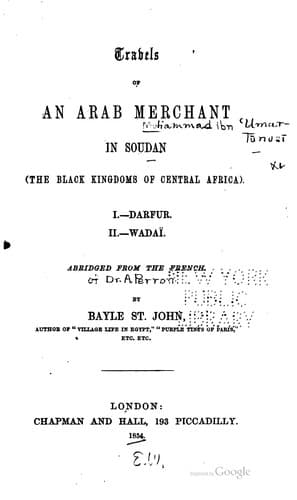
Travels of an Arab merchant in Soudan (the Black Kingdoms of Central Africa)Tūnisī, Muḥammad ibn ʻUmar
History
Travels of an Arab merchant in Soudan (the Black Kingdoms of Central Africa)
Tūnisī, Muḥammad ibn ʻUmar
Darfur (Sudan) -- Description and travel; Wadai (Sultanate) -- Description and travel
there several years, being only let loose to bear a child.
The most lucrative article of commerce in Darfur and Wadaï is red
copper, which brings almost its weight in gold. Next comes zinc,
and then tallaris and latten, in leaf. All these things are brought
by the Jellabs, or slave-merchants, on their return journeys.
The Arabs of the neighbouring desert import other articles, as melted
butter, oxen, cows’ hides, and honey. The Rezeigat, especially,
bring large quantities of butter. Other tribes trade in salt, which
they fetch from the wells of Zaghawy. This substance is much sought
after in Darfur, where it is often sold one measure for twenty
measures of millet. The salt of Mydaub is especially set apart for
the viziers and other great people. That of Zaghawy is the worst
that can be found in the world, being mixed with great quantities
of earth. People in easy circumstances dissolve it in water, which
they strain off, and afterwards allow to evaporate. Verily! if
the Forians were to behold salt like that of Rosetta or Tunis,
they would fight for it sword in hand. The Falgo salt, found in
the Marrah mountains, is used in pieces as money.[51]
As might be expected, industry is little developed in Central
Africa. In Darfur and Wadaï there are no trades scarcely but those
of the weaver, the blacksmith, the cultivator, the spinner, and the
founder, that is to say, the maker of lances, of bows and arrows,
and some rough utensils for agriculture and the ordinary uses
of life. In Darfur there are strangers from Katakou, who dye in
blue, with indigo, and know how to produce the varying blue-black
tints of the Godeny and the Teykan. The Forians are very clever in
tanning skins, for which they have all the necessary implements
and substances. They prepare, with the hides of oxen and camels,
sacks, and large fine pieces of leather, which are used to sit or
sleep upon, or to bolt wheat. With the skins of goats they make
excellent bags for carrying travelling provisions. With sheep-skins,
red or green, they cover scabbards or saddles.
There are scarcely any other arts in Darfur than those which I have
indicated. The wants which in civilised countries have created the
professions are satisfied by mutual assistance. Neighbours shave
the heads of one another, and then there is no need of barbers. If
a man requires a house, he calls in his friends, and pays them with
a dinner and supper, and so there is no need of builders.
Public-domain text, read in full here on John Shaqi.
Reviews
Reviews
No reviews yet
Be the first to share your thoughts on this work.
Elsewhere in the archive
Join the Discussion
Join the discussion
Sign in to leave a comment or review.
Sign InorCreate an account