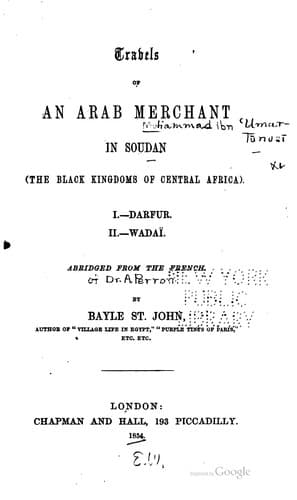
Travels of an Arab merchant in Soudan (the Black Kingdoms of Central Africa)Tūnisī, Muḥammad ibn ʻUmar
History
Travels of an Arab merchant in Soudan (the Black Kingdoms of Central Africa)
Tūnisī, Muḥammad ibn ʻUmar
Darfur (Sudan) -- Description and travel; Wadai (Sultanate) -- Description and travel
If a man dies, a friend, and, above all, a Fakih, performs the last
duties, washing the corpse and burying it, for every one knows the
simple ceremonies necessary. If a woman dies, the funereal duties are
performed by some old person of her own sex. To carry the corpse to
the burial-place, they knock up on the spot a rough litter, made of
two sticks with cross strings. Upon this is placed a kind of bed,
made of mats. The corpse is placed thereon, and thus taken to the
place where the friends of the deceased have dug a grave, which
is in all cases separate from any other. Neither those who wash
the corpse, nor those who carry it, receive any kind of payment;
and no charge whatever is made by those who recite the Koran for
the repose of the soul of the deceased, or who repeat the prayers of
deliverance, or who tell the chaplet of pardon. There is, therefore,
no need of undertakers or priests in that country.
In Darfur I have seen the prayers of the chaplet counted by means of
little fragments of reeds. Whoever wants to take part in these kind
of prayers cuts ten small fragments of reed and ten large ones. When
he has pronounced on his ordinary chaplet the first hundred of La
Illah il’Allah—“There is no other God but God,” he puts aside
one of the small pieces of reed; after the second hundred, he puts
aside another piece; and so on until all the ten are united. Then
he knows that he has articulated a thousand times his confession
of faith. In order to count the thousands, he puts aside one of the
large pieces of reed, so that at last he knows exactly when he has
uttered the sacred words ten thousand times. The Forians pretend
that the fragments of reed thus used acquire beneficent virtues. If
they are burned near a fever patient, they at once cure him. The
ashes mixed with water form an effective collyrium, which cures
ophthalmia, if applied three days successively in the morning. Some
of the fragments placed between a corpse and its shroud induce God
to treat the soul of the deceased with benevolence, and not to
be severe in the appreciation of its faults. Fraternal charity,
in reference to the will of God, is a common thing in Darfur. He
upon whom any misfortune falls is always succoured by his friends
and those who know him.[52]
The Forian women have no knowledge of the domestic labours to which
the women of civilised countries are accustomed to. The daughters of
the rich spend a part of the day in adorning themselves; in rubbing
their bodies with butter and their hair with grease, in putting kohl
in their eyes, in perfuming themselves, and curling their hair. When
they have finished they occupy themselves with household duties,
and then pass their time in making fine mats with slips of daum
leaves, which they have stained of different colours—red, black,
green, or yellow. These mats are light and handsome, and seem to
invite those who see them to sit down and sleep.
Public-domain text, read in full here on John Shaqi.
Reviews
Reviews
No reviews yet
Be the first to share your thoughts on this work.
Elsewhere in the archive
Join the Discussion
Join the discussion
Sign in to leave a comment or review.
Sign InorCreate an account