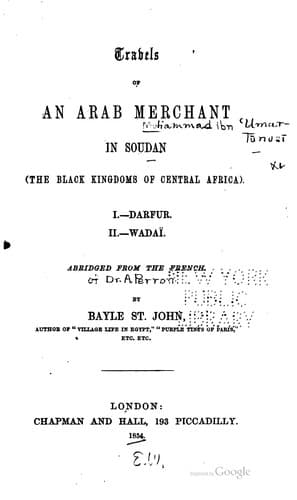
Travels of an Arab merchant in Soudan (the Black Kingdoms of Central Africa)Tūnisī, Muḥammad ibn ʻUmar
History
Travels of an Arab merchant in Soudan (the Black Kingdoms of Central Africa)
Tūnisī, Muḥammad ibn ʻUmar
Darfur (Sudan) -- Description and travel; Wadai (Sultanate) -- Description and travel
A Forian woman, of whatever class, generally prepares the food of her
husband and the guests who come to the house. The poor assist the
men in sowing and reaping, in gathering grain and cotton. At other
periods of the year they collect a store of fruit and many kinds
of wild grains for their families. It is they also who gather in
the water-melons, and pound them, and prepare them for eating. They
go out into the fields with their husbands and cut down the weeds,
which they collect for fuel. The very young girls keep the flocks,
and afterwards accompany their parents in their work. In the evening
it is the wife who brings home upon her head a great packet of wood
and dry grass or weeds, to serve for the purposes of cookery and
to light up the huts.
The poor people generally endeavour to buy each a she-goat or a
sheep, on the milk of which they live. They are in a most frightful
state of want and misery, suffering from the tyranny of their
governors and the exigencies of war. Their life is that of slaves.
Let us turn from the consideration of these humble topics to
that of the government and the constitution of the country
of Wadaï. _Certes_, the most powerful and the most respected
sovereign in all Soudan was Sultan Saboun. It is the custom in
Wadaï to recognise as a prince only one who is born of a mother of
noble origin, whose genealogy is pure, and who belongs to one of
the five privileged tribes. The son of a slave, even if she were
a descendant of the Prophet, can never ascend the throne. I have
already traced back Sultan Saboun to the great Seleih, and it is
not necessary to repeat what I then said.
The functions and dignities of Darfur differ in nature from those
of Wadaï. In the latter country there are eight Kamkolaks; four of
the first rank and four of the second. They form a judicial tribunal,
whose decisions can never be reversed by the Sultan. If he has strong
reasons for blaming any particular sentence, and they persist in it,
he may discharge them, but he cannot reverse what they have decreed
without the assistance of the Grand Kadi.
The highest rank after the Kamkolaks is that of Momo, mother of the
Sultan; then comes that of Hobaba, or chief wife; and afterwards are
ranged the Aguid, the Viziers, the Kamna, and the Turguenak. Then
follow the kings of the mountains, the governors of secondary rank,
and the kings.
Twice a-week, on Mondays and Fridays, the Wadaïan Sultan gives a
public audience to receive the complaints of his people. On the
Monday he occupies a room which overlooks the Fasher, where are
the lines of trees I have mentioned, under which is established the
tribunal of the Kamkolaks, indicated by a line of lances stuck up in
the ground. The judges remain there all the morning and afternoon,
and only go away during the great heat, or when it rains. As I have
mentioned, it is also under a tree that the Sultan gives audience
on Friday.
Public-domain text, read in full here on John Shaqi.
Reviews
Reviews
No reviews yet
Be the first to share your thoughts on this work.
Elsewhere in the archive
Join the Discussion
Join the discussion
Sign in to leave a comment or review.
Sign InorCreate an account