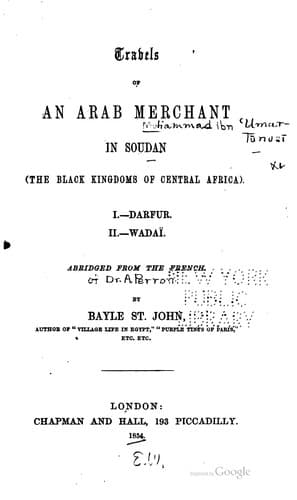
Travels of an Arab merchant in Soudan (the Black Kingdoms of Central Africa)Tūnisī, Muḥammad ibn ʻUmar
History
Travels of an Arab merchant in Soudan (the Black Kingdoms of Central Africa)
Tūnisī, Muḥammad ibn ʻUmar
Darfur (Sudan) -- Description and travel; Wadai (Sultanate) -- Description and travel
Then the Kadi, the Muftis, the Ulemas, the Shereefs, and other
great people, each according to his rank, squat down on the ground
before the Sultan, between whom and the crowd is a row of seven
interpreters, ranged one behind the other. Amongst the Forians
the people begin by uttering their salutations; but in Wadaï no
one speaks before the Sultan. The interpreters repeat his words,
saying: “Kadi, the Sultan salutes thee; Ulemas of Islam, the
Sultan salutes you;” and so on through all the various ranks
until they come to the people. The individuals of each category,
as soon as they have been addressed, clap their hands and incline
their heads even to the earth, at first on the right hand and then
to the left. During this ceremony, and almost without interruption,
the baradieh and tambourine resounds behind the Sultan, and whenever
its notes are strengthened the whole assembly accompanies it by
a gentle clapping of hands. At the same time the soldiers, who
are ranged standing round the crowd, brandish and strike together
the iron rods which they hold in each hand. This beating of the
tambourine, this clapping of hands, this clashing of weapons, is
mingled, moreover, with the cries of the soldiers, who shout out,
“Glory to thee, O Sultan! Buffalo of intrepidity! May God make
thee victorious over our enemies,— thee, our master!” All these
sounds make a strange and savage concert.
The Kabartou form a choir who in public ceremonies sound the
trumpet and beat the tambourine; they also act as executioners. In
the weekly assemblies they sit on a slightly-raised platform, some
of them furnished with long trumpets, which assist in increasing
the clamour. When the music ceases to play, the Turguenak advance,
armed with clubs, the knobs of which are covered with iron. They
wear steel headpieces, and most of them have coats of mail, whilst
others have a thick-padded tunic, to protect them in battle against
arrows. Each company is headed by two drums, which are beaten with
tremendous violence. They march through the crowd, and then round
between it and the Sultan, making as if they would strike the
spectators, and crying: “Ask pardon of God and the Prophet.”
Public-domain text, read in full here on John Shaqi.
Reviews
Reviews
No reviews yet
Be the first to share your thoughts on this work.
Elsewhere in the archive
Join the Discussion
Join the discussion
Sign in to leave a comment or review.
Sign InorCreate an account