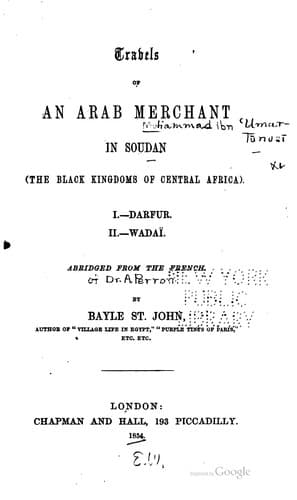
Travels of an Arab merchant in Soudan (the Black Kingdoms of Central Africa)Tūnisī, Muḥammad ibn ʻUmar
History
Travels of an Arab merchant in Soudan (the Black Kingdoms of Central Africa)
Tūnisī, Muḥammad ibn ʻUmar
Darfur (Sudan) -- Description and travel; Wadai (Sultanate) -- Description and travel
Some poor devils of Wadaïans heard one day that honey was a
marvellously sweet thing, and agreed to go to the Sultan and ask
for a taste. They accordingly went to Warah, and, waiting till the
prince came out, prostrated themselves, and explained the nature of
their visit. The Sultan flew into a passion, and exclaimed,—“Do
you mean to make fun of me by coming to talk of a thing of so little
importance? Let a whole skinful be brought.” He was obeyed, and the
poor fellows were ordered to eat the whole on pain of death. They
soon began to be disgusted; their stomachs heaved; they could not
go on. Then the Sultan ordered them to be shut up with the skin,
and given nothing to eat until they had swallowed the whole.
Formerly the Sultans were equally simple with the peasants. Three
men once raised three crops of onions, of red pepper, and of garlic,
and each went with a camel-load to make a present to the Sultan. The
latter, who did not know these vegetables in their natural shape,
being told that they were condiments, was charmed with the handsome
colour of the pepper, and put some into his mouth. He instantly felt
a burning sensation, and exclaimed: “These people are rascals,
and have come to poison me! let them be put in prison until they have
eaten all that they have brought, and nothing else.” The order was
executed, and the three peasants were kept in confinement for three
years, when they were let out; two of them afflicted with dreadful
diseases, and the third, who had fed on garlic, in good health.
Some insatiable smokers, who had no money left to buy tobacco,
determined to go and ask the Sultan for some. The prince was angry,
and ordered a huge pipe-bowl to be made, three cubits in height,
and filled with tobacco, with ten tubes—the number of the beggars
attached; and ordered them to smoke the whole. After a few whifs,
however, they all fainted, and were sent away with a warning not
again to make such absurd requests.
Formerly the Sultan of Wadaï was not allowed to drink milk;
for, said the Wadaïans, if the Sultan drinks milk, what shall his
subjects drink? At length, however, the prince took it into his head
to have a milch cow; the people rose in insurrection and ordered
him to get rid of it, and he was compelled to obey. This custom,
however, is now abolished.
In great ceremonies the Wadaïans wear ample turbans, but the
common head-dress is the tarboosh. Their chief garment is a
loose gown, generally of black stuff, made of narrow stripes sewed
together. Nearly every one carries a short sword, and a dagger tied
to the arm above the elbow. When a man is appointed to any high post,
the Sultan himself places a turban on his head.
Public-domain text, read in full here on John Shaqi.
Reviews
Reviews
No reviews yet
Be the first to share your thoughts on this work.
Elsewhere in the archive
Join the Discussion
Join the discussion
Sign in to leave a comment or review.
Sign InorCreate an account