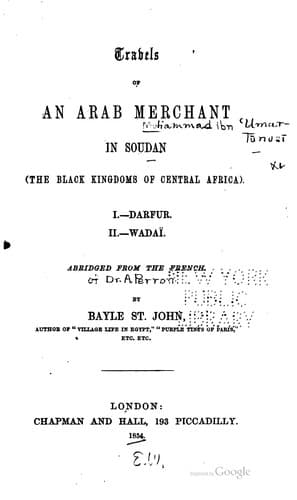
Travels of an Arab merchant in Soudan (the Black Kingdoms of Central Africa)Tūnisī, Muḥammad ibn ʻUmar
History
Travels of an Arab merchant in Soudan (the Black Kingdoms of Central Africa)
Tūnisī, Muḥammad ibn ʻUmar
Darfur (Sudan) -- Description and travel; Wadai (Sultanate) -- Description and travel
In Wadaï the people do not enliven their amusements by music;
the drums, tambourines, and trumpets are only used in public
ceremonies. I have already mentioned the use of frontlets for the
horses. These ornaments are much better worked in Darfur than in
Wadaï. Indeed, all the trades have an inferior development in
the latter country. The lances used are much less handsome; on the
other hand, the Wadaïans are much braver than the Forians.
The costume of the women of Wadaï resembles that of the Forian
women; but they do not wear rings in their noses, replacing them by
pieces of coral or wood. Their handsomest ornament is the amchinga,
elegantly made of a number of crescents of silver, with coral
and amber.
The Wadaïan women have nearly always a toothpick in their hands,
and scarcely ever leave off using it except during sleep. Their teeth
are beautifully white, and their mouths deliciously sweet. They
wear a cloth tied round their loins, and a kind of cape made of a
piece of cloth, with a hole in the middle to cover their shoulders
and their bosom.
In general the Wadaïan men are robust, but not so black as the
Forians and Bagirmians. They do not disdain, as do the Forians,
the white colour, although the European complexion is not to their
taste. The whole nation is large and well developed. Young girls are
obliged to abstain from much food, for fear of acquiring too great
_embonpoint_. The women perform the greater part of the fatiguing
labour. They go to the market with two baskets, which they carry
poised on their shoulders like a pair of scales. They work in
the fields, fetch wood or water, and gather rice, tamarinds, and
karobs. It is the duty of the men to make war, to weave and spin,
and deal in the larger articles of trade, as cattle and slaves.
Public-domain text, read in full here on John Shaqi.
Reviews
Reviews
No reviews yet
Be the first to share your thoughts on this work.
Elsewhere in the archive
Join the Discussion
Join the discussion
Sign in to leave a comment or review.
Sign InorCreate an account