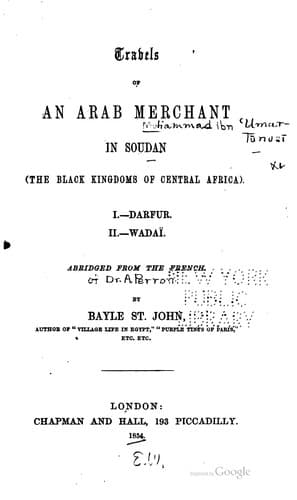
Travels of an Arab merchant in Soudan (the Black Kingdoms of Central Africa)Tūnisī, Muḥammad ibn ʻUmar
History
Travels of an Arab merchant in Soudan (the Black Kingdoms of Central Africa)
Tūnisī, Muḥammad ibn ʻUmar
Darfur (Sudan) -- Description and travel; Wadai (Sultanate) -- Description and travel
In Darfur and Wadaï the men mix freely night and day with
the women. Girls and married women do not scruple to pass their
nights with those who please them. Nothing can prevent lovers from
meeting. A Turguenak became enamoured of one of the concubine slaves
of Sultan Saboun, and was beloved by her also; yet the Sultan was
so fond of her that he had taken her with him on the Tamah war. She
corrupted the slaves, men and women, who served and surrounded
her, and escaped from the tent of the Sultan at night to meet her
lover. But this came to the knowledge of Saboun, who put her to
death, and gave to his Viziers and Ulemas all her accomplices, who
were very beautiful. My father received two. “When,” he used
to say, “Saboun told me to take my choice, I did not know which
to prefer; as each passed before me she seemed more beautiful than
the former. I was embarrassed; but, fearing to appear ridiculous
by my indecision, I shut my eyes, and advancing thus, seized two at
haphazard.” My father afterwards learned that one of these girls
had long been in love with the Kamkolak Kidermy, and accordingly
sold her to him for a horse worth four slaves, ten young girls of
six spans, and a magnificent camel. The other, called Zoheirah,
was beloved by my father for some time; but he sold her at Tunis
because she misbehaved herself.
I have already related how the old women in Darfur introduce youths
dressed as girls into harems. These intrigues, in my opinion, are
caused by the system of having so vast a number of women as the
property of one man. Evidently there is disproportion in this; and
we must not be surprised if the women, under these circumstances,
in the fullness of youth, undergo all kinds of dangers. It is
customary in Wadaï not to force the affections of women. If
a girl attaches herself to any one, her choice is left free;
and if, out of ten suitors, one is distinctly chosen, the nine
others are forbidden ever afterwards to address her, except as
“my sister,” to which she replies, “my brother.” But if,
after her first choice, she transfer her affections to any other
of the nine, then is the beginning of jealousy and enmity. Now,
it happened that two friends became enamoured of a beautiful girl,
and requested her to choose between them. She did so, and the other
said to her, “Thou art now my sister.” But, some time afterwards,
she became weary of her first lover, and desired the other, whose
passion also revived. But he feared, if he confessed his sentiments,
to incur the reproaches of his friends and the hatred of his rival,
and to be the cause of misfortune. He therefore took his friend
apart, and said to him,—“Thou knowest that women are the causes
of collision and struggles between men; learn that thy mistress
wishes to separate from thee, and throw herself into my arms;
but I fear to accept her, lest we should become enemies. If thou
wishest to know the truth, I will seek an interview; and thou shalt
Public-domain text, read in full here on John Shaqi.
Reviews
Reviews
No reviews yet
Be the first to share your thoughts on this work.
Elsewhere in the archive
Join the Discussion
Join the discussion
Sign in to leave a comment or review.
Sign InorCreate an account