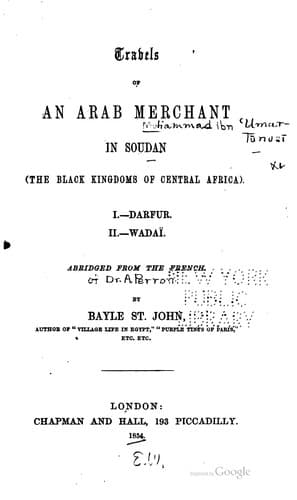
Travels of an Arab merchant in Soudan (the Black Kingdoms of Central Africa)Tūnisī, Muḥammad ibn ʻUmar
History
Travels of an Arab merchant in Soudan (the Black Kingdoms of Central Africa)
Tūnisī, Muḥammad ibn ʻUmar
Darfur (Sudan) -- Description and travel; Wadai (Sultanate) -- Description and travel
hide thyself, and afterwards thou shalt be free to choose whether
thou wilt abandon her with reproaches, or whether I shall go away
and remain absent until she has forgotten me.” This plan was
agreed upon, and the interview took place in the hearing of the
first lover. The girl did not scruple to avow her new affection,
declared that she repented of her first choice, said that love was
replaced by hatred, and showed herself willing to abandon herself to
new caresses. Upon this the hidden lover, unable to contain himself,
rushed forward and stabbed her. Then the two friends agreed to cut
her in pieces and bury her, which they did; and no one knew the
truth until after the death of the murderer. Ah! how perfidious
are women! May Heaven never, never forgive an unfaithful woman! The
mercy of God be on the author of the following words:—
“Of women there are certainly some that are worth eighty
she-camels; but there are others not worth the skin of a foal. May
God, in his goodness, burn all unfaithful women in hell for
ever!”[54]
I have already said that the Wadaïans are brave. This character is
more strongly developed, of course, in the young men, when their
heads are heated with inebriating drinks. Their conversation, at
such times, becomes often coarse and brutal, and quarrels, in which
blood is shed, often arise. Those who are especially distinguished
for courage and pride are called Afrits, or devils. These men at
once render themselves terrible by their murders and robberies. They
frequently exercise their violence near the wells of Saboun, which
are not far from the Fasher, and in more distant places their
boldness is still greater. Whenever one of these Afrits loves
a woman, he marries her in spite of all opposition. One of them
declared his love for a young girl, and asked her in marriage; but
she detested and refused him. He persisted, and went every evening,
killing the suitors he found there. He thus frightened every one
away, but without succeeding in winning her affections. She almost
passed the marriageable age. However, one day, a stranger beheld her
at the market-place, and loved her, and followed her, and accosted
her, declaring his sentiments.
“In truth,” said she, “thou art a handsome fellow, and I love
thee already; but, as the proverb says, ‘there is an obstacle in
the way of the ass.’”
“Art thou married?”
“No.”
“What withholds thee, then?”
“What? why, one of those savage Afrits has forbidden any one to
approach me.”
“Why does he not marry thee?”
“I do not love him, and will not have him.”
“Is he related to thee?”
“No! by Heaven!”
“Well, then, fear nothing, and I will release thee from him.”
“That is not so easy,” said she; “and yet, by Heaven, I am
not a coward, and do not fear the Afrit! It is for thee that I fear,
lest he assassinate thee.”
“Be easy on that point,” replied he; “but only show me thy
dwelling.”
Public-domain text, read in full here on John Shaqi.
Reviews
Reviews
No reviews yet
Be the first to share your thoughts on this work.
Elsewhere in the archive
Join the Discussion
Join the discussion
Sign in to leave a comment or review.
Sign InorCreate an account