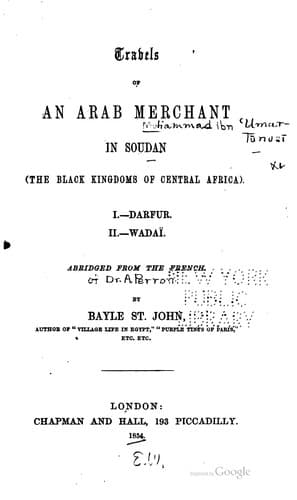
Travels of an Arab merchant in Soudan (the Black Kingdoms of Central Africa)Tūnisī, Muḥammad ibn ʻUmar
History
Travels of an Arab merchant in Soudan (the Black Kingdoms of Central Africa)
Tūnisī, Muḥammad ibn ʻUmar
Darfur (Sudan) -- Description and travel; Wadai (Sultanate) -- Description and travel
Each chief of a squad now takes a different route, and passes
through the towns and villages beating a tambourine, collecting the
inhabitants, communicating the contents of the firman, pointing
out the conditions offered by the undertaker of the hunt, and
promising, for example, that the owner of the salatieh will only
take, at the first jebayeh, or division of spoil, the third of the
slaves which each hunter has taken, and at the second division
a quarter. Generally a certain number of young Forians, of poor
families, join the expedition.
The master of the salatieh also stops in the places which he
traverses to collect companions, and having rested awhile in his own
village, proceeds to the general rendezvous. Once there, he takes the
title of Sultan, and composes a kind of court out of those to whom
he has delivered copies of the firman. There have been sultans of
Ghazwah who have found themselves at the head of nine or ten thousand
people or more. His court is a perfect imitation of the court of the
real Sultan. He delivers clothes to his body-guard, and distributes
to them his camels, his asses, and his horses. Sometimes a great
many people come flocking in without having been recruited; but all
are obliged to admit the absolute authority of this temporary sultan.
The rules of distribution of the products of the hunt are fixed and
known. All slaves taken without resistance fall to the lot of the
sultan, amongst whose perquisites, likewise, are the presents given
by the kings of the adjoining provinces. The expedition pushes
on as far as it can, and then one evening it is announced that
the division of profit is to be made the next day. This division
takes place as follows:—The sultan causes a circular enclosure,
or zeribeh, with two openings, to be made. The people of the Ghazwah
come early in the morning with the slaves they have caught. If the
sultan is reasonable, he takes only a third, but he sometimes exacts
one-half. The zeribeh is made of prickly branches. The sultan sits in
the middle, and his servants station themselves at the issues. Then
all the slave-catchers, one by one, bring in their lots, the number
of which is immediately written down. If there are only two, the
sultan takes the better, and the other is left to his owner, who
receives a paper, certifying that he has submitted to the law of
partition. He who has only taken one slave is put aside until another
in the same predicament comes, when the sultan takes one and leaves
the other to be divided. All those kept by the sultan remain in
the zeribeh. This ceremony lasts sometimes ten days, or even a month.
When the division has been made, the master of the salatieh
pays his debts, and then continues the hunt, returning, however,
towards Darfur. When within a few days’ march there is a second
division made.
Public-domain text, read in full here on John Shaqi.
Reviews
Reviews
No reviews yet
Be the first to share your thoughts on this work.
Elsewhere in the archive
Join the Discussion
Join the discussion
Sign in to leave a comment or review.
Sign InorCreate an account