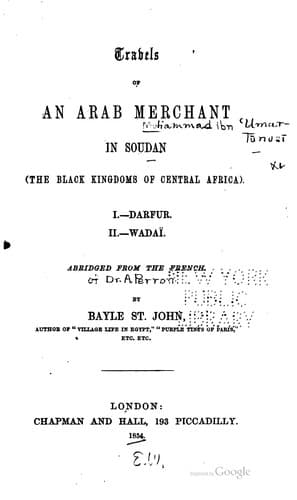
Travels of an Arab merchant in Soudan (the Black Kingdoms of Central Africa)Tūnisī, Muḥammad ibn ʻUmar
History
Travels of an Arab merchant in Soudan (the Black Kingdoms of Central Africa)
Tūnisī, Muḥammad ibn ʻUmar
Darfur (Sudan) -- Description and travel; Wadai (Sultanate) -- Description and travel
The Sheikh now reverts to his last voyage to Fezzan, and gives
further details. After this he promises to write what befell him
during his pilgrimage to Mekka, and in a visit he subsequently
made to the Morea; but this portion of his work he has not yet
executed. I have thought it best to give but a mere outline of
the concluding section of his travels. What I have presented will
impart some idea of the kind of life led by these Oriental wandering
merchants, and enable us to understand the working of the Mohammedan
social system, and especially of polygamy. The reader will not have
failed to perceive that the intercourse of the sexes becomes almost
fortuitous; that filial and parental affection are necessarily
weakened and nearly destroyed; and that natural sentiments, though
they show themselves now and then, do so in a merely episodical
and unimportant way. The great bane of Muslim civilisation is this
idea, that women are an article of property. The worthy Sheikh,
who so regrets his Abyssinian girl, forgets to tell us what became
of Zeitoun. He had loved another slave also, but had endeavoured to
change her away to satisfy a momentary caprice. These reflections,
however, will have suggested themselves to the sagacious reader.
THE END.
* * * * *
London: Printed by G. BARCLAY, Castle St. Leicester Sq.
FOOTNOTES:
[Footnote 1: If the reader should wish to consult Dr. Perron’s work in
the British Museum, he will find the “Voyage au Darfour” under the
head “Muhammad Ibn Umar,” in the Old Catalogue, p. 98 _b_; and the
“Voyage au Wadaï” under the same head in the New Catalogue. I believe
that, after “Mehemet,” it would be impossible to select a system of
spelling more likely to mislead in pronunciation. The Arabic version
will be found in the New Catalogue—also under Muhammad, but further
on, p. 103 _a_.]
[Footnote 2: See the introduction for observations on the chronology
of the Sheikh.]
[Footnote 3: It will be observed that our Sheikh here drops all
allusion to his mother, who, perhaps, to a certain extent, abandoned
him. Altogether, this narrative illustrates the slightness of the
family bond in the East.]
[Footnote 4: The Arabs rarely start on a journey on Friday before the
mid-day prayer, it being considered unlucky.—_Perron_.]
[Footnote 5: The Sheikh had better fortune, if his memory did not
betray him, than most travellers. It generally takes a good day’s sail
to reach as far as Benisouef.]
[Footnote 6: This was during the French occupation of Egypt.]
[Footnote 7: The Darfur caravan still starts from the same
neighbourhood.]
[Footnote 8: The eunuchs of high rank in Darfur marry, that they may
appear to have a family.]
[Footnote 9: Rashid was one of the titles of the Orphan.]
[Footnote 10: Basy is a title meaning great, and is applied to most of
the courtiers.]
Public-domain text, read in full here on John Shaqi.
Reviews
Reviews
No reviews yet
Be the first to share your thoughts on this work.
Elsewhere in the archive
Join the Discussion
Join the discussion
Sign in to leave a comment or review.
Sign InorCreate an account