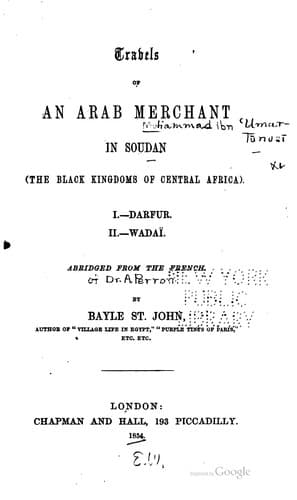
Travels of an Arab merchant in Soudan (the Black Kingdoms of Central Africa)Tūnisī, Muḥammad ibn ʻUmar
History
Travels of an Arab merchant in Soudan (the Black Kingdoms of Central Africa)
Tūnisī, Muḥammad ibn ʻUmar
Darfur (Sudan) -- Description and travel; Wadai (Sultanate) -- Description and travel
[Footnote 11: It is evident that this is the account of a partisan;
and, if we could interest ourselves in these distant politics, we
might perhaps become convinced that Zawanah was the victim of that
jealousy and fear which all powerful foreigners excite in Darfur. We
shall presently see that, in one case at least, Abd-er-Rahman did not
merit the title of Rashid. It is very possible that he regretted the
wealth he had bestowed upon the Mamlouk.]
[Footnote 12: The Sheikh, who had already abandoned his personal
narrative to relate the historical incidents that preceded or were
contemporary with his residence in Darfur, now assumes a didactic
tone, and gives the result of his observations, interspersing personal
adventures and anecdotes. It is, perhaps, necessary to repeat that
Darfur is pronounced Darfoor.]
[Footnote 13: Aghadez, described in Mr. Richardson’s “Mission to
Central Africa.”]
[Footnote 14: It is possible that some filthy custom of this kind,
among our ancestors, was the origin of the contemptuous expression of
lick-spittle.]
[Footnote 15: Read the private histories of most courts for instances
equally absurd: the origin of high cravats, of shaving in some
periods, of beard-wearing in others; of long hair, of short hair, of
wigs, of pantaloons; of Protestantism, of Romanism, of adultery, and
piety. The poor Forians, falling off their saddle, in imitation of
their sovereign, would, perhaps, feel offended by this comparison.]
[Footnote 16: A similar ceremony is celebrated in China by
the emperors.]
[Footnote 17: This singular custom of concealing the face with the
Litham, as a mark of sovereignty, is found in most parts of Central
Africa. The whole conquering tribe of Touaricks, and, indeed, all
people of Berber race, keep it up. I noticed it at Siwah.]
[Footnote 18: I once saw at Cairo a Zikr of the kind, in which a woman
stood behind the performers and excited them by her singing.]
[Footnote 19: Previously called Anbousah. See p. 45.]
[Footnote 20: In Egypt I have observed that, in spite of the great
number of black concubines, there absolutely exists no class of
mulattoes. The children almost all die young.]
[Footnote 21: The Sheikh gives a detailed account of the operation, as
also of various other kinds of treatments for different diseases,
which it may be curious for medical men to consult. I have no doubt
that many barbarous nations are in possession of valuable medical
secrets.]
[Footnote 22: So the Forians, as well as the English, regard as a
delicacy meat in which the process of putrefaction has commenced.]
[Footnote 23: The zhalym has on each wing eight beautiful white
plumes, and the rabdah eight grey ones.]
[Footnote 24: I suppose this is the same tree as the tholukh, so often
mentioned in Mr. Richardson’s “Journal.”]
[Footnote 25: Chloroform?]
[Footnote 26: This royal way of paying debts appears to be common in
Soudan. See the exploits of the Sarkee of Zinder, in Richardson’s
“Journal.”]
Public-domain text, read in full here on John Shaqi.
Reviews
Reviews
No reviews yet
Be the first to share your thoughts on this work.
Elsewhere in the archive
Join the Discussion
Join the discussion
Sign in to leave a comment or review.
Sign InorCreate an account